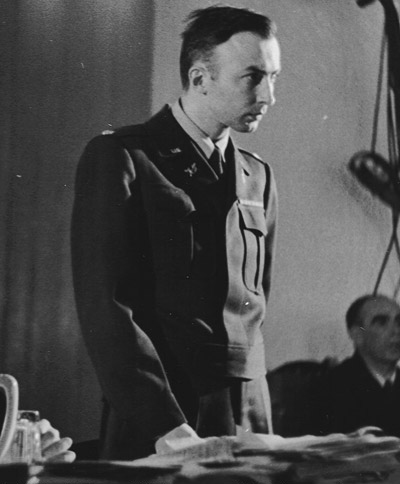
Denson drove to JAG rear headquarters in Munich—known affectionately as “Lucky Rear”—where the Dachau trials were being prepared. He arrived at the Munich inn that would be his new home, unpacked quickly, and set out in his jeep for Dachau. Munich had been heavily bombed in the final weeks of war, and roads were strewn with rubble from toppled buildings. He drove out of the ruined city and into fields and hills in the bloom of summer. Six miles west he crossed a stone bridge, traversed a long road flanked by poplars and a row of look-alike houses, and drove through the gates of the camp.
The bodies were gone, but everything else was as it had been at liberation. The crematorium chimney rose from its brick foundations near the Schiesstand, or execution wall. The ground beneath the wall was still stained rust red, and the smell of blood was still strong. He walked around the periphery of mass graves, beneath the limbs of hanging trees, across the roll call yard. A large area inside the camp was enclosed with barbed wire. Inside the holding cage were barracks. German prisoners moved in and out of the buildings. Some of them watched him as he made his way around the camp.
He entered the Records Room, a twenty-by-thirty-foot office. Wooden shelves and metal cabinets lined the walls. He took folders from a shelf and read reports of men, women, and children crowded together like cattle, suffocating in sealed boxcars. He read of typhus epidemics that went unchecked, killing more than three thousand inmates per month. He read statements by liberation soldiers who had discovered emaciated prisoners lying on bunks saturated with blood and excrement. He read interviews with victims who spoke of medical tortures, beatings, grossly inadequate food, scant clothing in subzero winters, nonexistent sanitation, and numbers of people killed, numbers so large they made him dizzy.
Denson exited the Records Room, lit a Lucky Strike, and wondered what in heaven’s name he had walked into. Years later he confessed to simply not believing what the evidence told him. Lynching and torture had always been exceptions to human behavior, not the rule; and Germany was the home of classical music and philosophy, not the barbarism these reports described. He did not believe because his religious training rejected the notion of absolute evil, yet biblical descriptions of the Apocalypse did not come close to the nightmares of Nazi camps. He did not believe because Harvard Law School had taught him to distrust circumstantial evidence, illogical reports, and anything his innate intelligence found suspicious. Like most Americans, he had read a few articles and knew prisoners had been killed in the camps. But mass murder on this scale was unfathomable. Denson did not believe because believing would mean that the world was not the neat and tidy place he’d always thought it to be. A man is born, be it in Birmingham, Alabama, or Warsaw, Poland. He grows up, studies hard, works sincerely, serves God, leads a good life, and is entitled to expect that such sacrifice and decent behavior will bear fruit. But from these reports, leading a virtuous life had proved useless against Nazi terror. Even worse, virtue proved to be a deficit in the camps. Gestures of kindness were rewarded with floggings and death. Goodness and mercy were luxuries from a privileged world: they had no place in Dachau. When Germany’s first concentration camp opened its gates, a crack had appeared in the structure of things, and now the army was saying he was responsible for sealing the fissure.
He did not believe because believing would mean giving up the provincial, mannerly approach to law that had been his style until now and turning ruthless in pursuit of convictions. Bill Denson had never been a ruthless man.