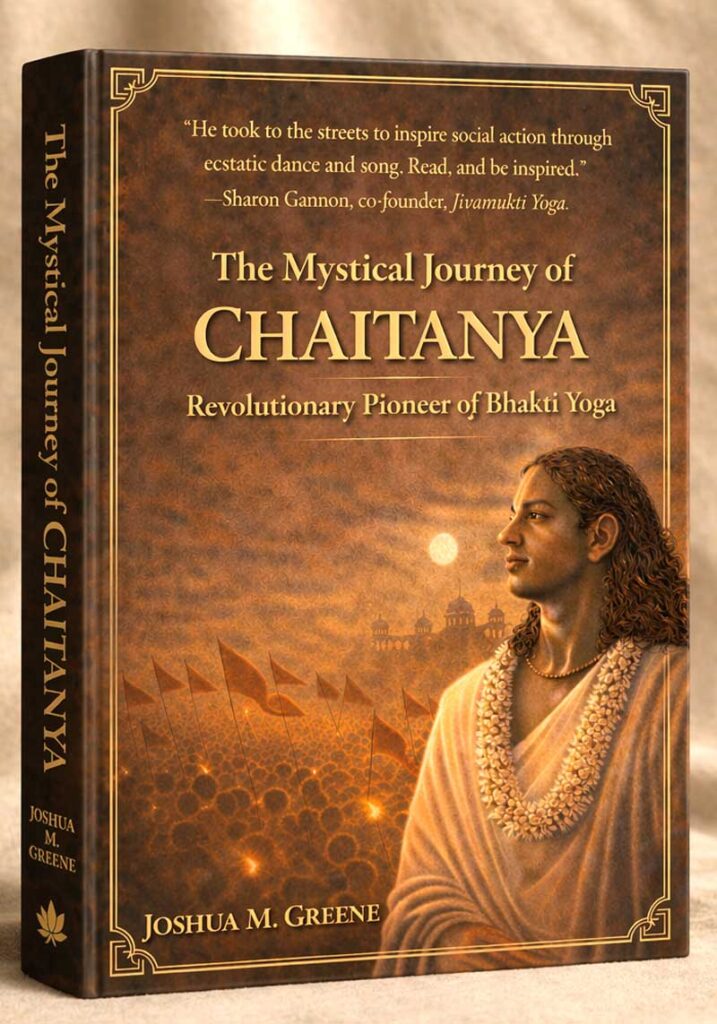
The Mystical Journey of CHAITANYA

The Mystical Journey of CHAITANYA – book cover

TO BE RELEASED IN FEBRUARY 2027

The Mystical Journey of

CHAITANYA

Revered, vilified, worshiped, condemned, forgotten, then resurrected onto a world stage, Chaitanya (1486-1533) is one of the most controversial figures in mystic history. One hundred years ago, Gandhi modeled his nonviolent protests on Chaitanya’s peaceful demonstrations. In the 1950s, Martin Luther King paid homage to both Gandhi and Chaitanya by emphasizing nonviolence and songs of protest in his civil rights movement. Starting in the 1960s, the Beatles popularized Chaitanya’s signature songs. Today, Chaitanya’s mantra meditation is a staple practice in yoga studios worldwide.

Millions know his songs and practices, yet hardly anyone knows him. Chaitanya is arguably the most unknown famous person in the world. 

In his time, he was one of India’s greatest spiritual leaders, a social reformer whose ecstasies of devotion and dedication to fighting racial oppression won him a following in the millions. He was also a husband, son, brother, scholar, poet and a lover of God whose movement continues to grow worldwide. 

Based on detailed research and rare documents, The Mystical Journey of Chaitanya presents his story with you-are-there immediacy—and epic tale of struggle, renewal, and the forces that determine history. Chaitanya’s teachings are as relevant, applicable, and urgent today as they were five hundred years ago.

How Martin Luther King Led Me to Sixteenth-Century Mystic Chaitanya

There are moments that shape an entire life. One occurred for me in 1966, when Dr. Martin Luther King Jr. came to speak at my high school, Fieldston, in the Bronx. I was sixteen, a reporter for The Fieldston News and was assigned to cover his talk. He walked onto the stage, calm and radiant, and spoke about conscience as the engine of change. He told us that the arc of the moral universe bends toward justice, we sang “We Shall Overcome,” and I scribbled notes, unaware that I was being guided toward a story that would take nearly sixty years to tell.
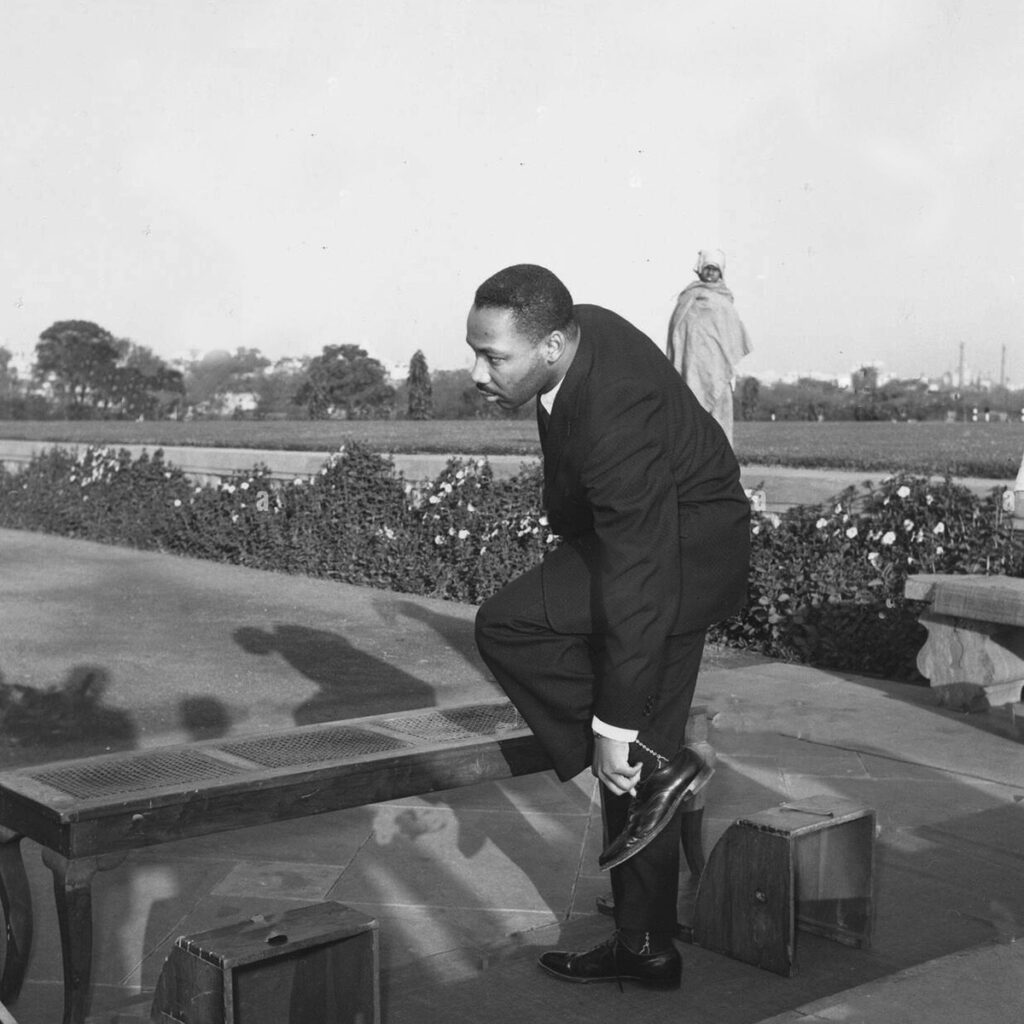
MLK in India
1959 – Dr. Martin Luther King, Jr. removes his shoes before entering Mahatma Gandhi's shrine.
Madison, 1967: Tracing a Pilgrimage

The following year I entered the University of Wisconsin–Madison and joined the staff of the Daily Cardinal. One of my first assignments: retrace Dr. King’s 1959 journey to India to learn about Gandhi’s nonviolent practices at their root. From the earliest days of the Montgomery bus boycott, King had described Gandhi as “the guiding light of our technique of nonviolent social change.” After the boycott’s success, he felt compelled to visit the land where that light had first been kindled.

Among other stops, King toured Bodh Gaya, the place of Buddha’s enlightenment. What I learned while researching that trip startled me. It seems Bodh Gaya had been the place where another pioneer of peace had achieved enlightenment five centuries earlier: Bengal saint Chaitanya, whose nonviolent protests against an oppressive government inspired Gandhi’s campaign.

The Hidden Lineage of Non-Violence

Chaitanya, a Vaishnava or worshiper of personal divinity, taught that all beings share the same spiritual essence, and that selfless, inclusive love is the ultimate peace formula. His public singing and dancing in the streets of sixteenth-century India defied rigid caste barriers and political opposition. Gandhi absorbed Chaitanya’s devotional impulse through his own Vaishnava upbringing and made ahimsa, the principle of non-harm, the essence of his freedom movement.

From Bodh Gaya, King traveled to Ahmedabad, where in 1930 Gandhi’s followers had chanted prayers made popular by Chaitanya. In his final broadcast from Delhi, King declared, “Since being in India, I am more convinced than ever before that the method of nonviolent resistance is the most potent weapon available to oppressed people in their struggle for justice and human dignity.”

This, then, was my unexpected discovery, that there was a lineage in the history of nonviolent protest from Chaitanya in 1500 AD to Gandhi in the 1930s to King in the 1960s. Yet the more I researched, the more it was clear that little had ever been written about Chaitanya for the general public.

Writing The Mystic Journey of Chaitanya

By the 1990s, my fascination with Chaitanya had grown into an obsession. Research led me through palm-leaf manuscripts, temple libraries, and Chaitanya’s songs and prayers still sung in Bengal’s villages. Each encounter felt like a dispatch from the same moral universe King described: one in which love and respect for the dignity of all beings are the foundation of peace and civilized human society. In the early 2000s, after a decade of preparation, I set out to portray Chaitanya as a living force whose mystical experiences mirrored King’s comments at Fieldston a half-century before.

The Mystic Journey of Chaitanya does not focus on King or Gandhi directly, but it walks in their footsteps. It explores how Chaitanya, who began his career as a young scholar from Bengal, came to see divinity alive in every creature, and how that vision gave rise to a movement that traveled by foot, by song, by sheer joy across centuries and continents.

The Question That Abides

When I think back to that high school speech in 1966, I realize the seeds of my biography of Chaitanya were planted the moment King’s voice filled the hall. Back then, he challenged us to consider: What kind of love changes the world without spilling blood? Searching for the answer unearthed an unexpected link from the civil rights marches of the American South to the nonviolent protests of Gandhi’s freedom fighters, and back through time to Chaitanya’s followers singing and dancing in the early 16th century. Here was a chain of visionaries extending back five hundred years, inspired by the same impulse to help build a more just world. Telling the life story of the earliest of those pioneers, Chaitanya, reminded me that history’s greatest revolutions often begin in the quiet moment when one heart recognizes itself in another.
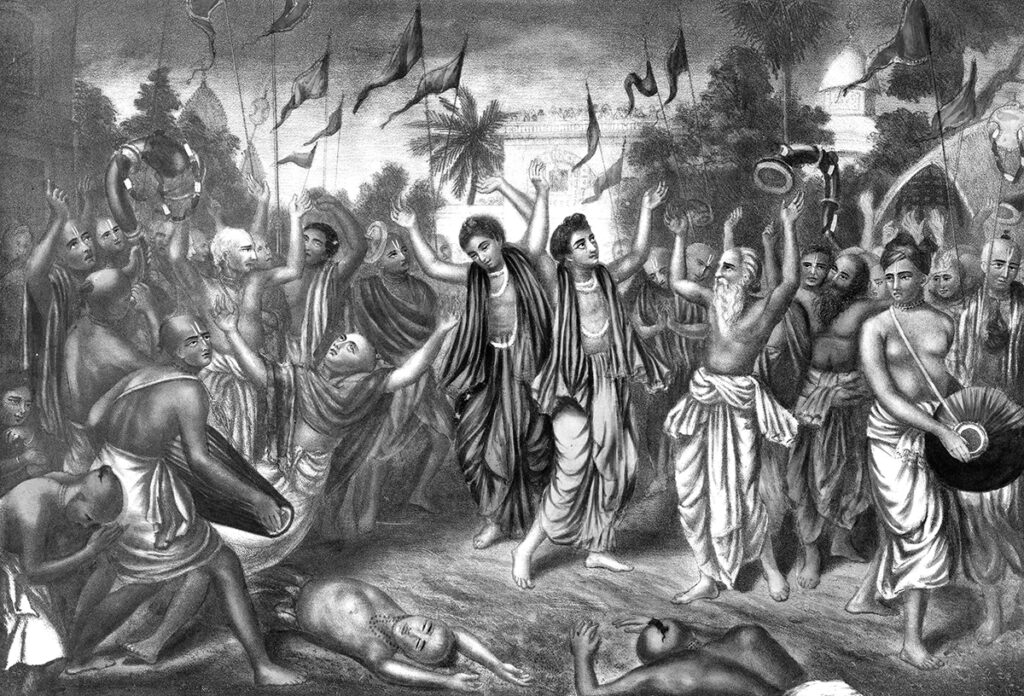
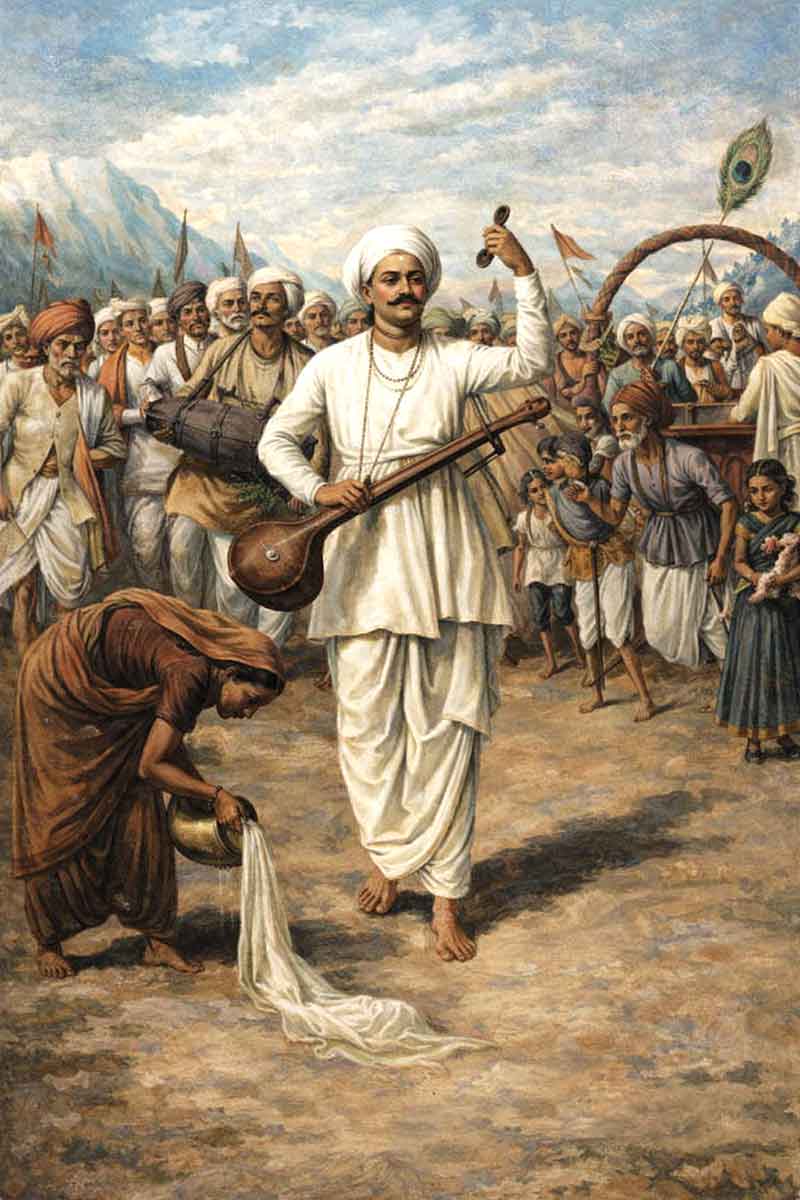
CHANTING 16TH CENTURY
1500 – Bengal, India. Chaitanya leads followers in performance.

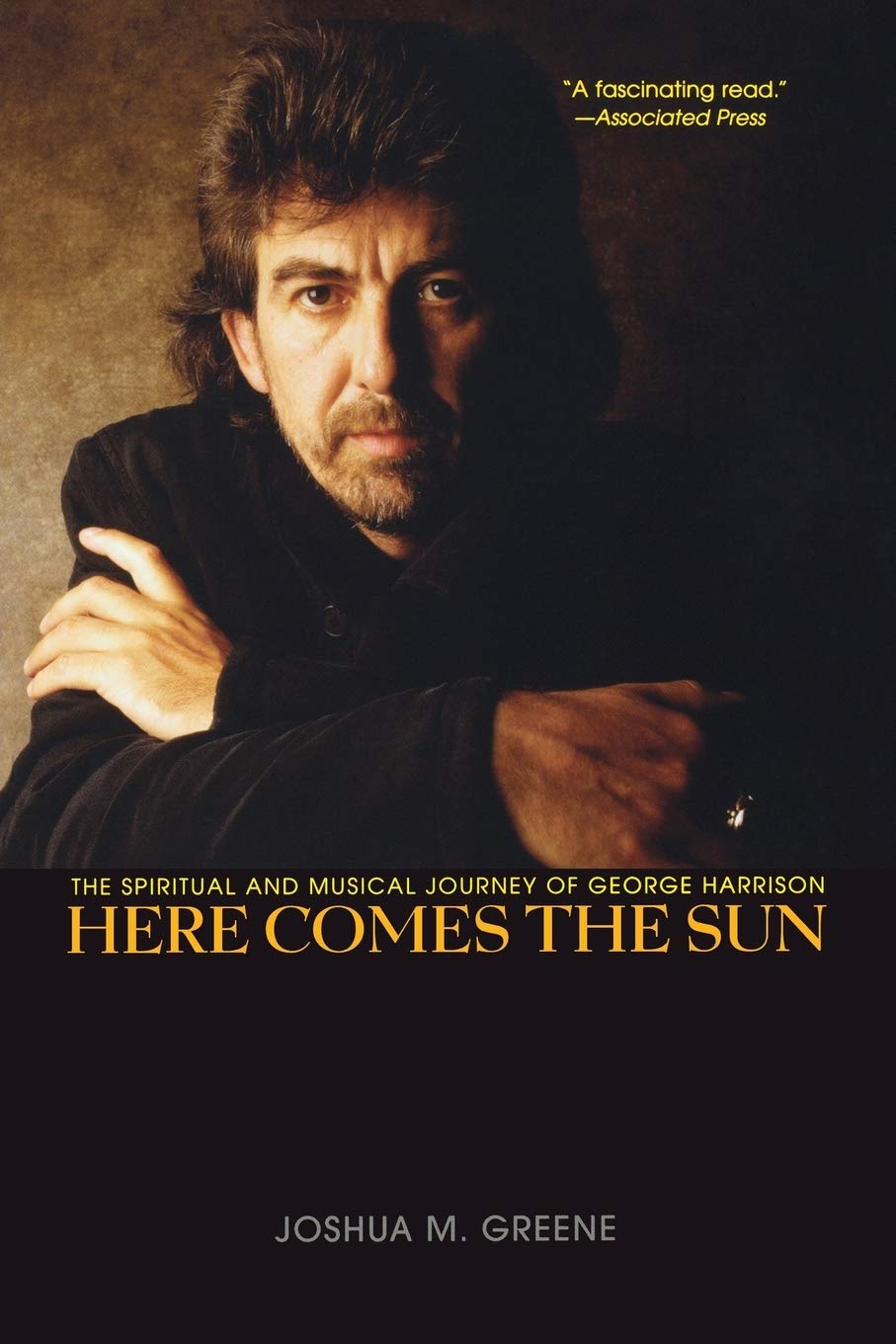
How the Late Beatle George Harrison Turned Chaitanya’s Mantra Into a Hit Record

Ancient Origins

There are combinations of words that change history. The Hare Krishna mantra (sacred sound)—Hare Krishna, Hare Krishna, Krishna Krishna, Hare Hare / Hare Rama, Hare Rama, Rama Rama, Hare Hare—is one of them. The mantra has its roots in India’s ancient Sanskrit texts, and the chanting was never just a ritual; it was a practice meant to awaken the eternal self, sleeping within the material body.

Chaitanya’s Revolution

In the 16th century, saint Chaitanya brought the mantra out of seclusion and into the streets. He and his followers sang it in public, accompanied by drums and hand cymbals. His movement was a joyful uprising that grew from his conviction that public chanting could revive the capacity for love.

Colonial Suppression

A hundred years later, when European merchants and missionaries arrived in India, they saw things differently. To them, the chanting was a primitive ritual from India’s past. Public singing of the Krishna mantra was marginalized and on occasion outlawed. Still, the practice never died, and in Bengal especially, it remained the heartbeat of spiritual life, waiting for its moment of renewal.

The Mantra Returns

That renewal came in the 19th century, when lost biographies of Chaitanya were rediscovered and the true meaning of the mantra was brought to light. In 1965, a Chaitanya follower, Bhaktivedanta Swami Prabhupada (1896-1977) boarded a steamship headed for New York City with just a few dollars and the determination to share the mantra with the world. He opened a small storefront center, and within two years he attracted a number of admirers. Among them was a music producer, who recorded him singing the Krishna mantra with his students.

The Beatles and Beyond

In 1966, during the Beatles tour of the U.S., when George Harrison first heard the mantra on U.S. radio, something clicked. “It sounded familiar,” he would later describe. In 1968, back in London, he met a few of Prabhupada’s students who had come to open a Krishna temple and were chanting on Oxford Street, in public performance following Chaitanya’s example.

Attracted by their sincerity and dedication to a life of devotion, George invited them to record the Hare Krishna mantra at Apple Studios. The recording was released in 1969 and to everyone’s surprise (not least the Apple Records accountants), it became a top ten hit, attracting listeners with its spiritual message broadcast on radios and televisions across Europe and America. For the first time in history, an ancient spiritual song had gone pop.

A Global Hit

From that point on, the mantra circled the globe. In the intervening half-century, the Krishna mantra has been sung at music festivals, chanted in yoga studios, and performed in most countries of the world. And here’s the surprise: the same mantra that uplifted villagers in Bengal five hundred years ago still brings smiles, still stirs hearts, still brings strangers together in song. At a time when the world often feels divided, when joy can feel scarce, with the help of George Harrison’s recording, the Hare Krishna mantra remains what it has been since the dawn of time: a reminder that beneath all differences, the human spirit longs for connection, music, and love.
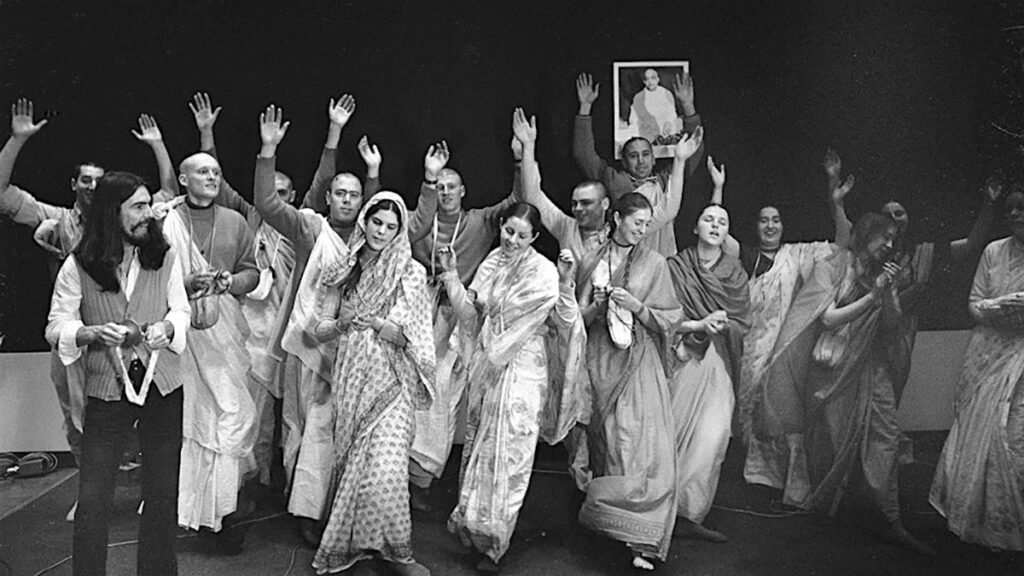
George Harrison - Kirtan
1970 – London. Krishna devotees record with George Harrison at Apple Studios.

Appreciations

The Mystic Journey of Chaitanya is the book that the world of spirituality has been waiting for. Joshua M. Greene has managed to liberate the story of medieval Indian mystic Chaitanya from the exclusive grip of hagiographers and academics, a story that for five hundred years has been inaccessible to modern audiences due to gaps in language, history, and culture. In this sensitive account, Greene effectively argues that Chaitanya—the avatar for Kali Yuga, the current age of crisis—was not just a spiritual revivalist, but an ecologist, humanitarian, and peacemaker who sought to lead humanity away from environmental destruction and back to the path of dharma—an urgent message, told here with literary appeal.”

Abeer Saha

Curator, National Museum of American History, Smithsonian Institution
5

“There are few books—let’s call them living books—that hold magic in their pages. The Mystic Journey of Chaitanya is one of them. You can almost hear Chaitanya’s ecstatic singing, smell the fragrance of the earth on which he walked, see the colors of the verdant forests, and feel the excitement of the masses who sang with him. As we read, we are touched by his timeless message that beyond lifeless materialism and empty religious dogma lies an eternal reality of which we are all a part. Joshua M. Greene has done an amazing job by drawing from various sources—traditional, modern, academic, folkloric—to create a fascinating picture of the Golden Avatar that enlivens and inspires with his timeless message.”

Sachinandana Swami, Gaudiya Vaishnava guru

author, Bhagavad Gita (German translation and commentary)
5

“In this splendid study, Greene envisions history as much as narrates it, employing a historical imagination that most historians would fail to achieve. In Greene’s work Chaitanya emerges life-like, in all his dramatic possibilities, immanent more than distant—a creative and persuasive blending of fact and faith and a treat for scholar and devotee alike.”

Amiya P. Sen

historian and author
4

“Over the past five hundred years, there have been many hagiographies of Chaitanya, and in the past century, there have also been scholarly studies of Chaitanya’s extraordinary life and teachings. The Mystic Journey of Chaitanya stands in a class of its own. This book combines the power of traditional narrative with the insights of historical scholarship to give us something unlike any previous rendition of Chaitanya’s life. Joshua M. Greene brings to life sixteenth-century India, gives us a front-row seat to the gripping events that unfolded in Chaitanya’s presence and draws us in the minds and hearts of his contemporaries. Greene does all this while never losing sight of what Chaitanya’s story means for us in the twenty-first century. This is a book that stays with you long after you have read it.”

Dr. Ravi M. Gupta

Charles Redd Chair of Religious Studies, Utah State University
5

“Greene retells the original Chaitanya narrative for readers unfamiliar with this period in history. Staying true to the story and respectful of the tradition from which it arises, he manages to convey the life of the Golden Avatar in a way that nonbelievers will appreciate. If you are someone seeking entrance into one of the most enduring tales that mystic India has to offer, this is the book for you.”

Steven J. Rosen

Author, "Chaitanyology"
founding editor, Journal of Vaishnava Studies
5

“In this absorbing biography of Lord Sri Chaitanya, readers gain insight into the transformative moment when the joyful singing of Krishna’s names began its journey around the world. For more than 500 years, followers have devoted themselves to perpetuating memory of that historic time as experienced by our ancestor, Lord Sri Nityananda Prabhu. No respectable account of Sri Chaitanya can be written without his blessings, and this moving biography has them. It is a magical account and a fitting introduction to one of the greatest spiritual dignitaries the world has ever known.”

Prabhupad Nitya Gopal Goswami, Acharya

14th generation descendent of Lord Sri Nityananda Prabhu
5

“Those of us who have dedicated our lives to preserving and perpetuating sacred sound know Chaitanya as the pioneer of kirtan culture. He was also a child prodigy, a renowned educator, a son, a husband, and later in life a lover of the Divine whose ecstasies are unmatched in mystic writings. Joshua M. Greene has written a beautiful, poignant, warmly personal biography. I loved every page.”

Jai Uttal

Grammy-Nominated kirtan vocalist
5

“Great teachers such as Chaitanya shine like the sun on everyone. He taught that chanting the holy names was the most effective way to create a sacred, loving space between one and all. We are in deep need of that space today, in need of knowing we are capable of loving and worthy of being loved. This biography achieves something wonderful: it brings readers inside the experience of being with him, inside that sacred space where they can feel their hearts open in the sunlight of true love.”

Krishna Das

Grammy-nominated new age vocalist
5

“To read about the lives of the avatars and saints is to have satsang, association, of enlightened minds. Author Joshua M. Greene offers us this rare opportunity in The Mystic Journey of Chaitanya, the sixteenth century spiritual activist and revolutionary who took to the streets to foster social action through ecstatic dance and soulful singing. This moving account of his life inspires us to also become living instruments of reform in the world. This book nourishes the soul and awakens your deepest, inner-most desires. Read, and be inspired.”

Sharon Gannon

co-founder, Jivamukti Yoga
5

“Joshua M. Greene presents us with an easy-to-read devotional literary narrative recounting the life of Chaitanya, the sixteenth-century saint, who founded the Gaudiya Vaishnavism movement. Greene’s biography is accessible, using his storytelling skills to capture with deep feeling the movement’s ideal of chanting the holy name to awaken the self.”

Alan Brill

Cooperman/Ross Chair of Jewish-Christian studies, Seton Hall University
author, "Rabbi on the Ganges: A Jewish-Hindu Encounter"
5

“Chaitanya comes to life in this remarkable narrative: his spiritual realization, his teachings, his relations with family and devotees, and his mission to spread sankirtan far and wide. His story unfolds with vivid reality as he and his companions move through the setting of sixteenth-century India. Its people of city and country, its great temples and devotional life, and its thrilling natural beauty are all portrayed in dense, glowing detail. Subsequent history and the author’s own reflections add welcome enhancements. Compelling, richly rewarding and illumining!”

Kusumita P. Pedersen

Professor Emerita of Religious Studies, St. Francis College
5
Tukaram

Pray No More For Oneness

Can water quaff itself?
Can trees taste of the fruit they bear?
He who worships God must stand distinct from Him,
So only shall he know the joyful love of God.
For if he says that God and he are one,
That joy, that love, shall vanish instantly away.

Pray no more for utter oneness with God.
Where is the beauty if jewel and setting were one?
The heat and the shade are two-
If not, where is the comfort of shade?
Mother and child are two.
If not, where is their love?
When after being sundered, they meet,
What joy they feel, mother and child!
Where is that joy, if the two were one?
Pray, then, no more for utter oneness with God.

— Tukaram (1608-1650)

Atomic bomb

Oppenheimer

“If the radiance of a thousand suns
were to burst at once into the sky
that would be like the splendor
of the Might One . . .
I am Death, destroyer of worlds.”

Robert Oppenheimer quoting Bhagavad Gita (11.12 and 11.32),
New Mexico, July 16, 1945,
on the first test of an atomic bomb.

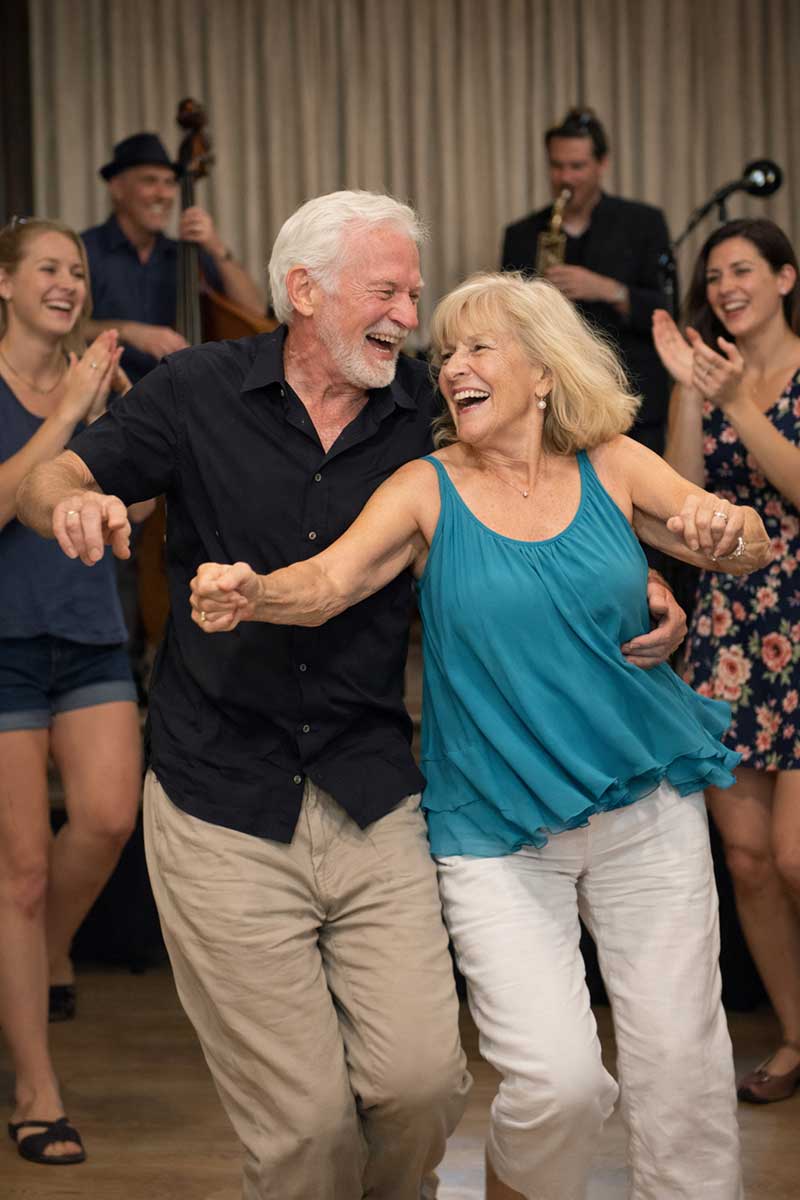
Older Couple Dancing

Dancing Your Heart Out

My dear friends, John and his wife, Marcia, are philosophy professors. They’re in their eighties now. They love to dance, and John once made a simple observation about dancing that marked me with its spiritual depth.

When people first learn to dance, he said, they often move mechanically, counting steps, repeating patterns, concentrating hard on “getting it right.” That stage is necessary. You have to learn the basics. But there comes a moment, if the learning has been sustained and patient, when the dancer stops practicing steps and starts being the dance. The concern over “getting it right” disappears and something freer takes over. And that, John says, is when life happens.

You can always tell the difference. A dancer who is still thinking about appearances may look good on the dance floor, but something’s missing. Dancers who don’t care about appearances and just feel the music move differently. Their bodies flow, free, loose, joyful. They’re not trying to dance. They’re dancing. In those moments, John says, we are most ourselves.

The distinction maps beautifully onto a classic idea in bhakti or devotional yoga: the difference between sadhana-bhakti, devotional life in practice, and ragatmika-bhakti, spontaneous devotion. In sadhana, daily practices such as chanting a prescribed number of mantras, studying sacred texts, showing up for worship even when the heart feels distracted or dry—that’s learning the steps. Sadhana seeks to instill discipline, repetition, structure, and intention, like a dance lesson, and it can feel mechanical at times. We follow patterns given by tradition. We imitate the great bhaktas who have progressed farther than we have. We practice not because it feels spontaneous, but because it forms us.

This stage is devotion’s foundation. Without a foundation, love and devotion have nothing to stand on. Just as no one wakes up one day dancing effortlessly. It takes practice. But sadhana is not the destination. It is the preparation for spontaneous love and devotion.

Ragatmika-bhakti describes devotion that has become internalized. Love moves the soul naturally, without calculation. In this place of spontaneous devotion, external judgements, defensive postures, and selfish interests dissolve. Devotion is no longer something we try to do. It arises on its own. The heart leans toward Krishna, the supreme being, the object of love dwelling in the hearts of all, the way a body leans toward its favorite music. There is still form, just as a skilled dancer still respects rhythm and balance, but the form is no longer constrained. It is alive.

In ragatmika-bhakti, practice shows what it has achieved. What once felt mechanical now feels alive and exciting. Devotion flows because it expresses who we have become. Neophyte dancers dance with their feet. The more seasoned dancers dance their hearts out.

John’s insight reminded me of something essential about the life of devotion that I’ve been trying to nurture for more than fifty years: spontaneity is not the opposite of discipline. It is the fruit that matures when discipline has been fully absorbed. The goal is not to remain forever counting steps, nor to abandon the steps prematurely. The goal is to practice so deeply that the practice disappears.

When devotion becomes like dancing at its best—unselfconscious, responsive, joyful—we are no longer “performing spirituality.” We are living it. And in those moments, as John says, we are finally ourselves.


Warlock

Visit from a Male Witch

I will never be sure about the events I’m about to describe. For years the images have been like pieces of stained glass in a church window, and the more I try to fit the pieces together, the more I cut my hands. But they did happen.

In February 1970, shortly after joining the London Hare Krishna devotees in their temple off Oxford Street, we were visited by a warlock, a male witch. London had an active community of occultists in those days (the Swedenborg Society, for example, named after an 18th century Swedish spirit-channeler, had its offices just next door), and the Krishna temple attracted hundreds of unusual visitors including yogis, sorcerers, and ecstatics who would pretend to fall into a trance and roll around on the carpeted temple floor. Every day we received someone new and strange, but the male witch has remained in my memory as among the most bizarre.

Male witches are rumored to have originated in Scotland. Ours was a heavyset man who sat quietly during the Sunday dinner, then insinuated himself into a discussion a few of us were having about mystic powers. In the group was Digvijaya, the temple cook. When the witch learned Digvijaya came from Scotland, he announced that he would come back that night.

“I’ll show yah a thing or tew aboot mystic powers,” he boasted. We had no idea what he meant.

This particular Sunday, there were more guests than usual. Midnight came and went, and still there were pots to wash. Digvijaya’s dedication to kitchen duties inspired me to stay and help. I also loved hearing his accent: he spoke with a beautiful Scottish brogue, and if we were admiring the stars that evening, he might say, “Ach, Yogesvara (my initiated name), ‘tis a braw, bricht, moonlicht nicht.”

His humility was as impressive as his accent. I asked him once, “Why do you like cooking for Krishna so much?” He said, “Ach, I’m not advanced enough to coook fer Krishna, but I looove coooking fer His devotees.” That was quintessential Digvijaya.

Attached to the basement kitchen was an airshaft that rose up the side of the six-story building. Around 1:00 a.m., we heard a rumble that sounded like a big wave gathering offshore. The sound grew louder, and suddenly, the door to the airshaft burst open and a blast of freezing cold air circulated fast and furious around the kitchen. Pots flew through the air as though in a hurricane.

Digvijaya dove under a table, shouting “Krishna! Krishna!” over and over.

I crept along the base of the wall and worked my way over to the airshaft. When I reached the door, I jumped up, rammed it shut, and bolted the lock. Immediately, things subsided. The pots fell to the floor, and the kitchen grew warm again.

Digvijaya and I looked at one another in shock.

“Has anything like that ever happened before?” I asked him in a whisper.

“Nooo,” he said, catching his breath, “and I surely hoope it dunna happen again.”

“Do you think it was that man who came to the feast?”

“Could be,” Digvijaya said with a shrug. “But I have a moore important question.”

“What’s that?”

“Ah cannot finish cleaning the pots muhself. Ken ya stay and help muh?”

I haven’t spoken to Digvijaya in more than a half-century, but his steadfast dedication to cooking and cleaning continues to inspire me. Even airborne witches couldn’t distract him from his prescribed duties.

Accelerator

Now on Display: Soviet Science And The Atma

Growing up in midtown New York City in the 1950s, I lived with my mother in a two-room apartment near Central Park. In those days, you could rent a small place in that neighborhood for a few hundred dollars a month. It strained our two-person budget, but she saw a chance to move us out of the slum area where we had been living downtown, and she took it.

Haircuts happened across the street from our building and next door to 1010 WINS radio, a rock ’n’ roll station back then. Next to the barbershop was a used bookstore. For twenty-five cents you could buy an ACE double-novel science fiction paperback. On the corner was a coffee shop serving bagels and coffee to riders pouring out of the 59th Street subway. And right beside our building stood the New York Coliseum.

Before it was torn down in the early 2000s, the Coliseum was the place for all the big expos and fairs. My good fortune was to make friends with a guard posted at a side entrance. Starting at age nine, I saw every show for free.

In August 1959, the Coliseum hosted the Soviet Exhibition of Science and Technology. For nine-year-old me, the biggest “wows” were two exhibits. One was a replica of Sputnik hanging near the entrance. The other was a particle accelerator. I remember it as a metal machine perhaps ten feet across, with thick copper windings, heavy magnets, and bold signs proclaiming: “This machine controls the invisible,” “This is how atoms obey us,” and “This is secret, powerful knowledge.” The message was unmistakable: the future belongs to those who master the smallest things.

Standing before that silent ring of metal and copper, I think I sensed for the first time that the most decisive forces in life were unseen. This machine claimed to reveal what could not be observed directly. The idea lodged itself in me that the cool parts of reality lived beneath the surface. If matter was animated by invisible forces, perhaps life itself contained something tiny and mysterious.

Ten years later, I was introduced to the Sanskrit wisdom text Bhagavad Gita, which described the atma, the nonmaterial self that animates mind and body. That idea felt less to me like something new than something remembered. The “wow” in the Coliseum turned out not to be about physics but about tracing consciousness back to its source. What turns matter from something inert into something living? What is that undeniable quality of inner experience that lets us know we are alive?

I didn’t understand it then, but that day at the Coliseum was a turning point. Curiosity became vocation, and the question of how things work gave way to a deeper question.

Who is it that knows?

Steam Liberation

A Schvitz And A Nosh

For my 60th birthday some years ago, my wife bought a steam function for my shower. She didn’t know it would provide me with an ideal metaphor for explaining kaivalya, the state of ego dissolution that is the goal of Shankarite monistic Advaita philosophy.

“Shankarite” refers to the teachings of the 8th-century philosopher Adi Shankara, who taught Advaita philosophy, which proposes that personhood is a-dvaita, not two, meaning the individual self (atma) and the ultimate reality (brahman), the totality of all energy in creation, are, at the deepest level, identical, with liberation equating to the achievement of this oneness. “Monistic” means when one gets there, when yogis reach the ultimate perfection of their practice, egos fall away, and they become formless, featureless, and “one” with God.

Here’s where the steam shower comes in. When the steam fills the shower space, outlines soften. The walls and glass door seem to disappear. Even the sense of where one’s body ends and the space begins blurs. There is a peculiar relief in this loss of definition. The sharp edges of ordinary life, the roles, anxieties, unfinished business, loosen their grip. For a moment, you are no longer someone. You are simply warmth, breath, sensation.

That experience is wonderful and can feel genuinely liberating. No more sorrow rooted in personal history. No more tragedy born of attachment, loss, or conflict. The burden of being a distinct self with all its aches and cares dissolves.

The Bhagavad Gita offers a different diagnosis of what liberation ultimately means. According to the Gita, the nonmaterial self does not truly dissolve or disappear upon awakening. It is immortal and does not merge into brahman like a drop into the sea. A drop may no longer be visible, but it never becomes a whole sea. The self remains eternal, conscious, and irreducibly individual. What changes after liberation is not the loss of identity, but the emergence of true identity: personhood freed from the egotism of the material world.

The freedom of kaivalya, the Gita suggests, is genuine but incomplete. It is a state of release, an absence of pain rather than the presence of fulfillment. The burdens of embodied life fall away, but so do the possibilities of relationship, creativity, and love. And because consciousness is by nature active and relational, that stillness does not satisfy forever. In time, the self seeks something more than relief. It seeks positive, meaningful joy, found not in erasure, but in loving exchange.

Next time you visit, you’re welcome to try the steam shower for yourself. Then we’ll get lunch.

O'Keeffe Sunflower

this most amazing day

i thank You God for most this amazing
day: for the leaping greenly spirits of trees
and a blue true dream of sky; and for everything
which is natural which is infinite which is yes

(i who have died am alive again today,
and this is the sun’s birthday; this is the birth
day of life and of love and wings: and of the gay
great happening illimitably earth)

how should tasting touching hearing seeing
breathing any-lifted from the no
of all nothing-human merely being
doubt unimaginable You?

(now the ears of my ears awake and
now the eyes of my eyes are opened)

e.e. cummings (1950)

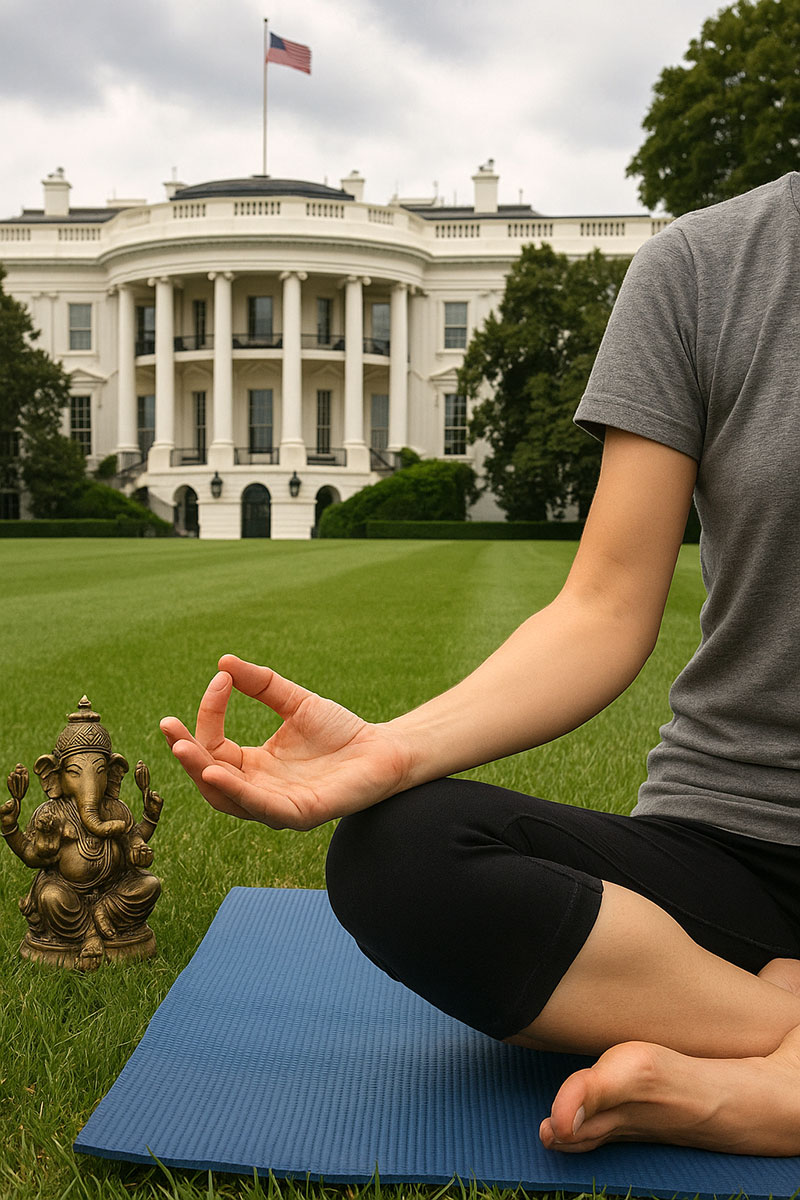
yoga at the white house

Yoga and the White House

When cultural identity narrows, even a yoga mat can become a battleground.

Few health practices are more commonplace in America today than yoga. Yet what looks like simple exercise continues to provoke unease. For some parents, the Sanskrit chants, statues of deities, and talk of “union with the divine” feel foreign, even unsettling—a quiet challenge to Judeo-Christian norms.

This unease might seem minor in the larger scheme of politics, but it raises a serious question: what happens to practices such as yoga if political authority in Washington continues to consolidate and cultural identity becomes ever more narrowly defined? The Constitution was designed to safeguard pluralism, yet those safeguards are being tested with increasing frequency. Executive power expands daily. Judges earn appointments not based on experience or expertise but perceived party loyalty. And public rhetoric around national identity frames “real America” in increasingly white Christian terms.

Against this backdrop, yoga becomes a revealing test case. School districts from Alabama to California have faced lawsuits over whether yoga in classrooms violates the separation of church and state. Defenders argue it has been thoroughly Americanized and is no more religious than a push-up, but critics frame it as covert Hindu indoctrination.

Both points hold some truth. Much of the yoga in the U.S. has indeed been stripped of its philosophical roots and repackaged as wellness. Yet the suspicion it still provokes shows how vulnerable cultural practices from outside the dominant tradition can be. History offers reminders. In the 19th century, Catholic schools were accused of undermining American values, and some states tried to outlaw them as un-American. During World War II, more than 100,000 Japanese Americans—two-thirds citizens—were uprooted from their homes and sent to internment camps. In the 1950s, McCarthy-era loyalty oaths forced teachers, professors, and artists to prove their patriotism or risk their livelihoods.

Each of these episodes has since been condemned, but at the time they were defended as necessary to protect national identity. The lesson is clear: when cultural difference is cast as a threat, constitutional protections can buckle quickly.

The White House itself has, at times, embraced yoga. Michelle Obama included it in her “Let’s Move” campaign, and sessions have been held on the South Lawn. But symbolic gestures fade when political winds shift, and practices once tolerated can become flashpoints.

This isn’t just about mats and mantras. It is about whether America can still make space for multiple traditions, as it has, often haltingly, in the past. The fate of yoga may matter less than whether freedom in America is strong enough to include the unfamiliar, or so fragile that the unfamiliar must be excluded.

And once that political chakra opens, it rarely closes.

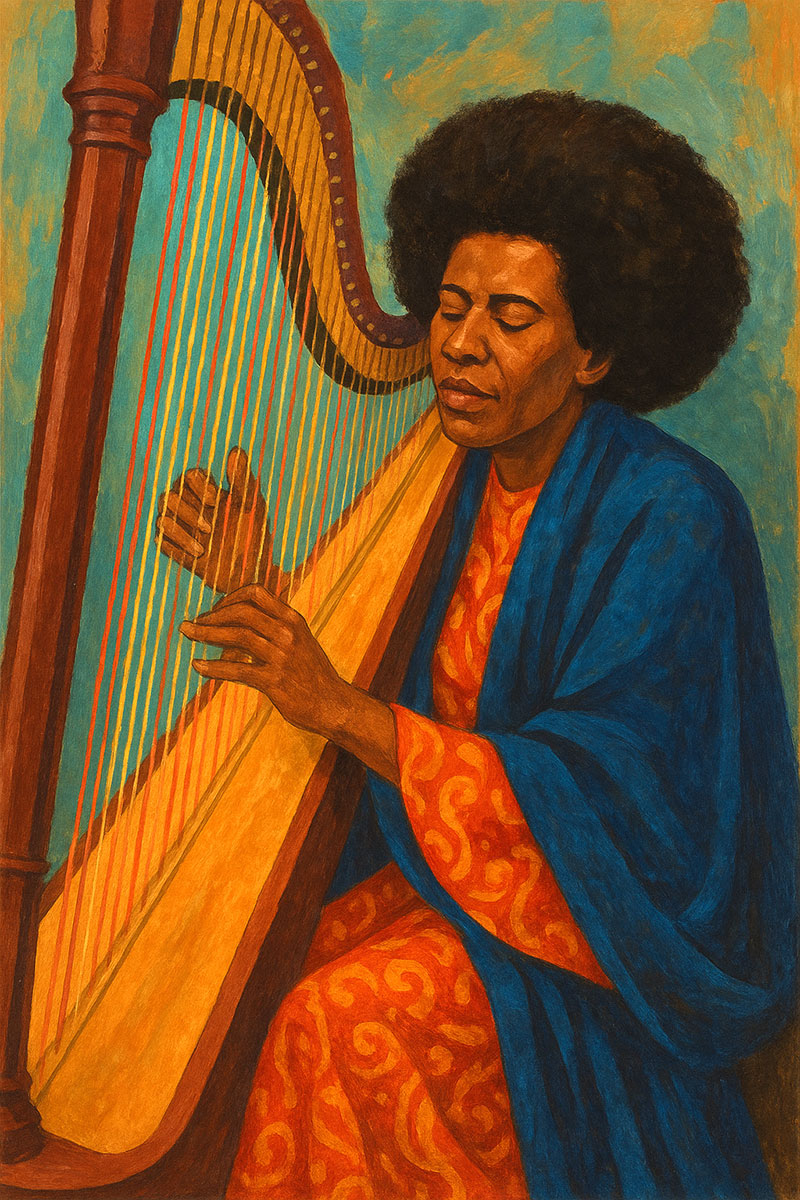
Alice Coltrane

Alice Coltrane

A LIFE IN MUSIC AND DEVOTION

Alice Coltrane (1937-2007) was a gifted musician, visionary composer, and devoted practitioner of yoga and meditation. In January 1981, when I was living in the New York Krishna temple, it was my privilege to help organize a musical tribute to John Lennon, and she agreed to take part. The program was to be a memorial offering to John, who had been murdered one month before.

George Harrison was the Beatle most admired for writing songs that were overtly spiritual; John was the fierce, questioning heart of the band, the one who confronted war and class prejudice and pushed the Beatles’ music into deeper revolutionary waters. For those of us who grew up in the 1960s, his murder marked the end of the sixties dream, a turning point that shattered the idealism we associated with the Beatles, counterculture, and John Lennon’s advocacy for peace. We baby boomers had come of age listening to his music. A memorial concert was the least we could do, and Alice’s participation was altogether fitting.

Most everyone involved with spiritual practices in those days knew about Alice Coltrane. In 1963 she met her future husband, the legendary jazz saxophonist John Coltrane, who credited yoga and meditation with having saved him from drug dependency. After his death in 1967, Alice became a disciple of Swami Satchidananda, founder of Integral Yoga. Soon after, she became known by the Sanskrit name Turiya Sangeetananda, meaning “the supreme being’s song of highest bliss.”

By the late 1970s, Turiya (as she was affectionately known) was a frequent visitor to Krishna temples and began incorporating the devotional music she heard there into her performances and compositions. In 1977 she sent a copy of her album “Radha-Krsna Nama Sankirtana,” featuring gospel-infused renditions of popular Sanskrit chants, to A. C. Bhaktivedanta Swami Prabhupada, founder of the Krishna movement. In March of that year, he sent her a letter of appreciation, praising her chanting and telling her she has become “transcendental” by chanting Govinda Jaya Jaya and the Hare Krishna maha-mantra. Shortly after, she met him in person while on a pilgrimage to Vrindavan, India.

In an interview for Integral Yoga Magazine, she described what it was like to be married to John Coltrane. “He was a very quiet, meditative person,” she said, “very pensive, very deep in thoughts. Many times, you see couples whose personalities are opposite and they clash a lot. That doesn’t make for peace in your heart and home. I felt fortunate to be with someone who had that calm and peace in his spirit. John loved to read spiritual books,” including the Bhagavad Gita and Paramahamsa Yogananda’s acclaimed Autobiography of a Yogi. “He was a person who wanted to look deeper into the esoteric side of life. We would meditate together.”

            While preparing for the John Lennon tribute concert, Turiya and I discovered that we had both met Swami Satchidananda at the Unitarian Universalist Church on Central Park West in the late 1960s. “For me to walk into the church and see so many young people gathered together was quite impressive,” she said. “I would see Peter Max, Laura Nyro and others there.”

The first time I heard Swami Satchidananda speak was at the church in July 1969, shortly before the Woodstock Festival, where he gave the opening address. “America is helping everybody in the material field,” he told the Woodstock crowd of nearly a half-million festival-goers, “but the time has come for America to help the whole world with spirituality also.” Then he led the crowd in chanting “Hari Om” and “Rama Rama.”

Turiya opened the tribute at the Krishna temple with a rousing version of the Hare Krishna mantra, but it was her rendition of prayers to the plant goddess Tulasi that got the place rocking. Her lively performance on Hammond organ, supported by two backup singers, had the audience of several hundred up and dancing.

What I remember most about that afternoon was the warmth of her singing. It was clear to all who were there that spirituality had brought her to higher dimensions of musical life. Clearly, she believed Krishna was present in his names, and that anyone could realize him if they sang the names with sincerity and devotion. She credited her late husband with having shown her the power of music and mantras.

“In his heart,” she said, “especially during the last five years of his life [from the time of his acclaimed album “A Love Supreme”], “it was all spiritual songs that came out: ‘Dear Lord, dearly beloved God, Om.’ We heard music coming from him that we hadn’t ever heard before, and I believe it wasn’t all from this world. He played from another realm, a spiritual realm.”

Alice Coltrane died of respiratory failure on January 12, 2007. Her music along with John Lennon’s—music that moves us to create a better, more compassionate world—lives on.