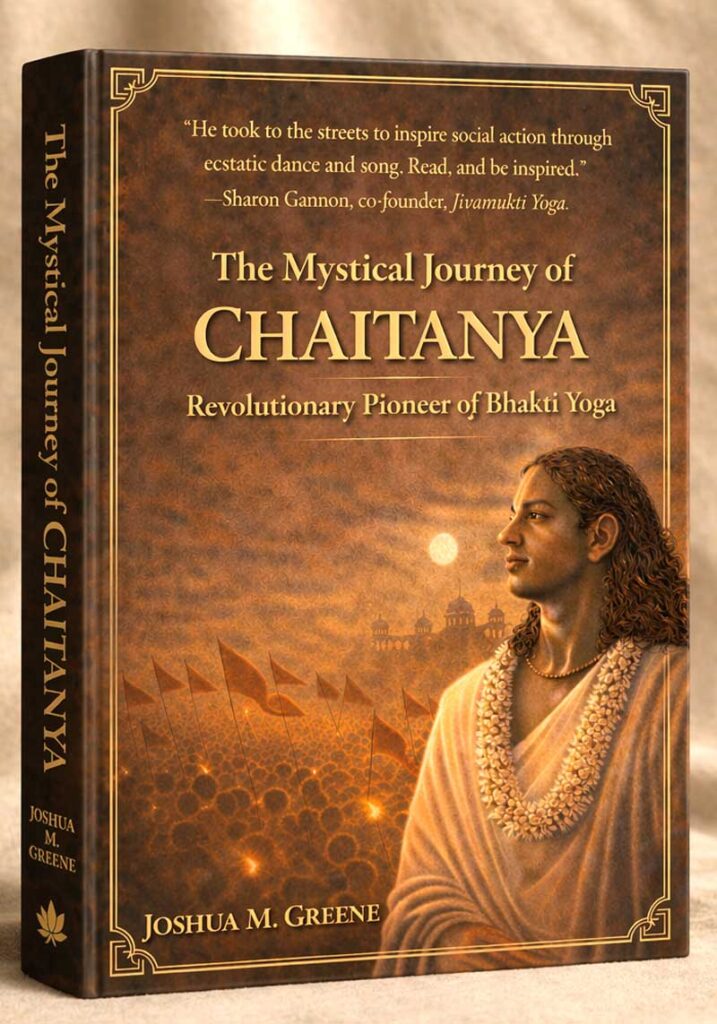
The Mystical Journey of CHAITANYA – book cover

TO BE RELEASED IN FEBRUARY 2027

The Mystical Journey of

CHAITANYA

Revered, vilified, worshiped, condemned, forgotten, then resurrected onto a world stage, Chaitanya (1486-1533) is one of the most controversial figures in mystic history. One hundred years ago, Gandhi modeled his nonviolent protests on Chaitanya’s peaceful demonstrations. In the 1950s, Martin Luther King paid homage to both Gandhi and Chaitanya by emphasizing nonviolence and songs of protest in his civil rights movement. Starting in the 1960s, the Beatles popularized Chaitanya’s signature songs. Today, Chaitanya’s mantra meditation is a staple practice in yoga studios worldwide.

Millions know his songs and practices, yet hardly anyone knows him. Chaitanya is arguably the most unknown famous person in the world. 

In his time, he was one of India’s greatest spiritual leaders, a social reformer whose ecstasies of devotion and dedication to fighting racial oppression won him a following in the millions. He was also a husband, son, brother, scholar, poet and a lover of God whose movement continues to grow worldwide. 

Based on detailed research and rare documents, The Mystical Journey of Chaitanya presents his story with you-are-there immediacy—and epic tale of struggle, renewal, and the forces that determine history. Chaitanya’s teachings are as relevant, applicable, and urgent today as they were five hundred years ago.

How Martin Luther King Led Me to Sixteenth-Century Mystic Chaitanya

There are moments that shape an entire life. One occurred for me in 1966, when Dr. Martin Luther King Jr. came to speak at my high school, Fieldston, in the Bronx. I was sixteen, a reporter for The Fieldston News and was assigned to cover his talk. He walked onto the stage, calm and radiant, and spoke about conscience as the engine of change. He told us that the arc of the moral universe bends toward justice, we sang “We Shall Overcome,” and I scribbled notes, unaware that I was being guided toward a story that would take nearly sixty years to tell.
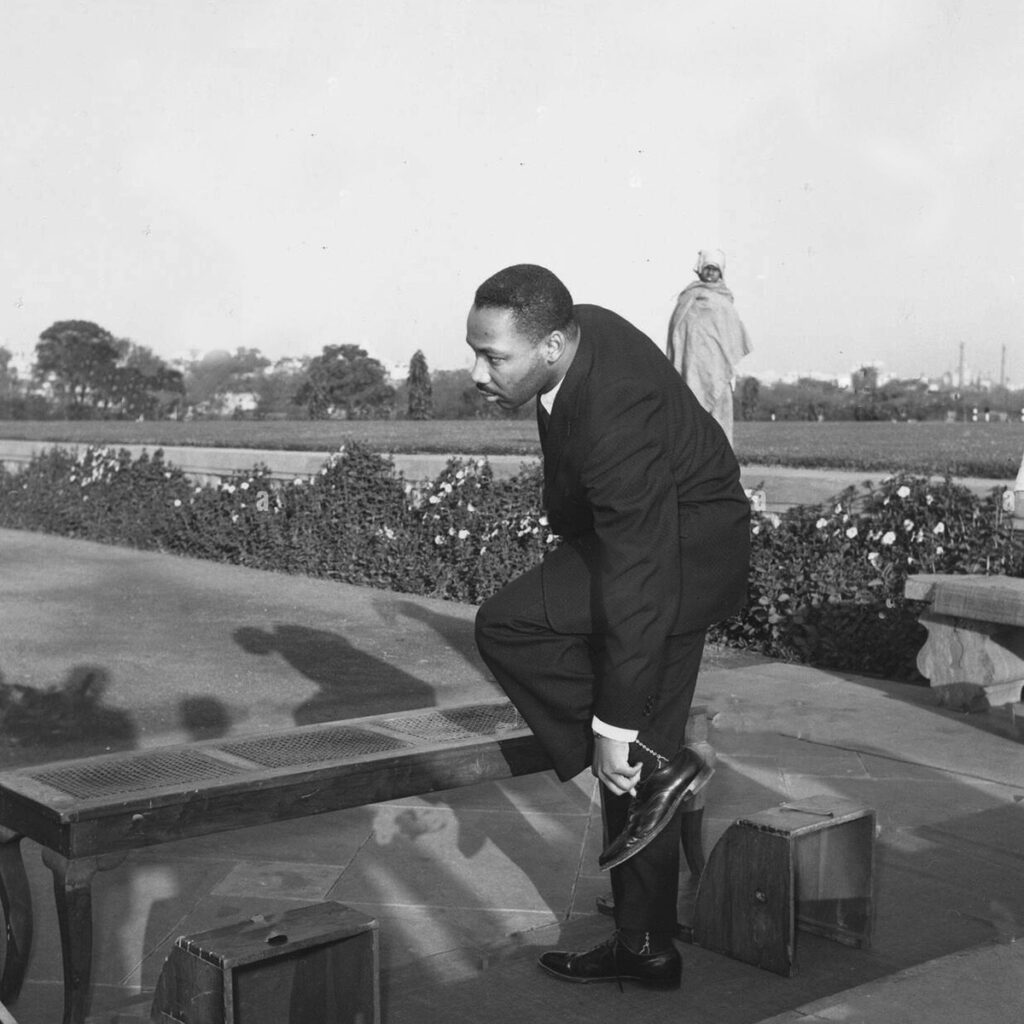
MLK in India
1959 – Dr. Martin Luther King, Jr. removes his shoes before entering Mahatma Gandhi's shrine.
Madison, 1967: Tracing a Pilgrimage

The following year I entered the University of Wisconsin–Madison and joined the staff of the Daily Cardinal. One of my first assignments: retrace Dr. King’s 1959 journey to India to learn about Gandhi’s nonviolent practices at their root. From the earliest days of the Montgomery bus boycott, King had described Gandhi as “the guiding light of our technique of nonviolent social change.” After the boycott’s success, he felt compelled to visit the land where that light had first been kindled.

Among other stops, King toured Bodh Gaya, the place of Buddha’s enlightenment. What I learned while researching that trip startled me. It seems Bodh Gaya had been the place where another pioneer of peace had achieved enlightenment five centuries earlier: Bengal saint Chaitanya, whose nonviolent protests against an oppressive government inspired Gandhi’s campaign.

The Hidden Lineage of Non-Violence

Chaitanya, a Vaishnava or worshiper of personal divinity, taught that all beings share the same spiritual essence, and that selfless, inclusive love is the ultimate peace formula. His public singing and dancing in the streets of sixteenth-century India defied rigid caste barriers and political opposition. Gandhi absorbed Chaitanya’s devotional impulse through his own Vaishnava upbringing and made ahimsa, the principle of non-harm, the essence of his freedom movement.

From Bodh Gaya, King traveled to Ahmedabad, where in 1930 Gandhi’s followers had chanted prayers made popular by Chaitanya. In his final broadcast from Delhi, King declared, “Since being in India, I am more convinced than ever before that the method of nonviolent resistance is the most potent weapon available to oppressed people in their struggle for justice and human dignity.”

This, then, was my unexpected discovery, that there was a lineage in the history of nonviolent protest from Chaitanya in 1500 AD to Gandhi in the 1930s to King in the 1960s. Yet the more I researched, the more it was clear that little had ever been written about Chaitanya for the general public.

Writing The Mystic Journey of Chaitanya

By the 1990s, my fascination with Chaitanya had grown into an obsession. Research led me through palm-leaf manuscripts, temple libraries, and Chaitanya’s songs and prayers still sung in Bengal’s villages. Each encounter felt like a dispatch from the same moral universe King described: one in which love and respect for the dignity of all beings are the foundation of peace and civilized human society. In the early 2000s, after a decade of preparation, I set out to portray Chaitanya as a living force whose mystical experiences mirrored King’s comments at Fieldston a half-century before.

The Mystic Journey of Chaitanya does not focus on King or Gandhi directly, but it walks in their footsteps. It explores how Chaitanya, who began his career as a young scholar from Bengal, came to see divinity alive in every creature, and how that vision gave rise to a movement that traveled by foot, by song, by sheer joy across centuries and continents.

The Question That Abides

When I think back to that high school speech in 1966, I realize the seeds of my biography of Chaitanya were planted the moment King’s voice filled the hall. Back then, he challenged us to consider: What kind of love changes the world without spilling blood? Searching for the answer unearthed an unexpected link from the civil rights marches of the American South to the nonviolent protests of Gandhi’s freedom fighters, and back through time to Chaitanya’s followers singing and dancing in the early 16th century. Here was a chain of visionaries extending back five hundred years, inspired by the same impulse to help build a more just world. Telling the life story of the earliest of those pioneers, Chaitanya, reminded me that history’s greatest revolutions often begin in the quiet moment when one heart recognizes itself in another.
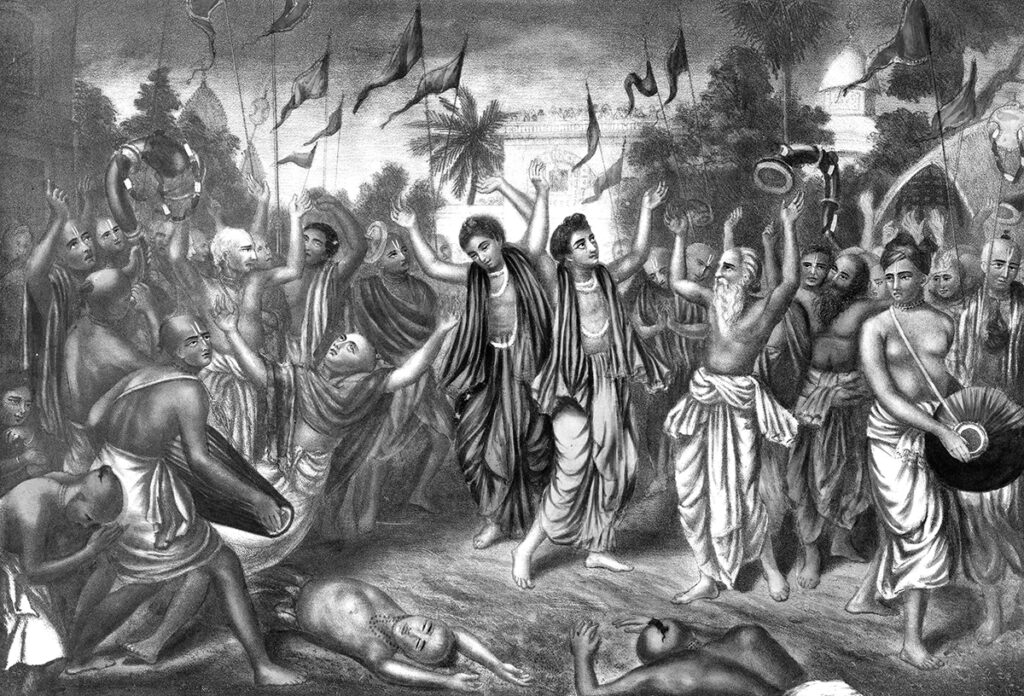
CHANTING 16TH CENTURY
1500 – Bengal, India. Chaitanya leads followers in performance.

How the Late Beatle George Harrison Turned Chaitanya’s Mantra Into a Hit Record

Ancient Origins

There are combinations of words that change history. The Hare Krishna mantra (sacred sound)—Hare Krishna, Hare Krishna, Krishna Krishna, Hare Hare / Hare Rama, Hare Rama, Rama Rama, Hare Hare—is one of them. The mantra has its roots in India’s ancient Sanskrit texts, and the chanting was never just a ritual; it was a practice meant to awaken the eternal self, sleeping within the material body.

Chaitanya’s Revolution

In the 16th century, saint Chaitanya brought the mantra out of seclusion and into the streets. He and his followers sang it in public, accompanied by drums and hand cymbals. His movement was a joyful uprising that grew from his conviction that public chanting could revive the capacity for love.

Colonial Suppression

A hundred years later, when European merchants and missionaries arrived in India, they saw things differently. To them, the chanting was a primitive ritual from India’s past. Public singing of the Krishna mantra was marginalized and on occasion outlawed. Still, the practice never died, and in Bengal especially, it remained the heartbeat of spiritual life, waiting for its moment of renewal.

The Mantra Returns

That renewal came in the 19th century, when lost biographies of Chaitanya were rediscovered and the true meaning of the mantra was brought to light. In 1965, a Chaitanya follower, Bhaktivedanta Swami Prabhupada (1896-1977) boarded a steamship headed for New York City with just a few dollars and the determination to share the mantra with the world. He opened a small storefront center, and within two years he attracted a number of admirers. Among them was a music producer, who recorded him singing the Krishna mantra with his students.

The Beatles and Beyond

In 1966, during the Beatles tour of the U.S., when George Harrison first heard the mantra on U.S. radio, something clicked. “It sounded familiar,” he would later describe. In 1968, back in London, he met a few of Prabhupada’s students who had come to open a Krishna temple and were chanting on Oxford Street, in public performance following Chaitanya’s example.

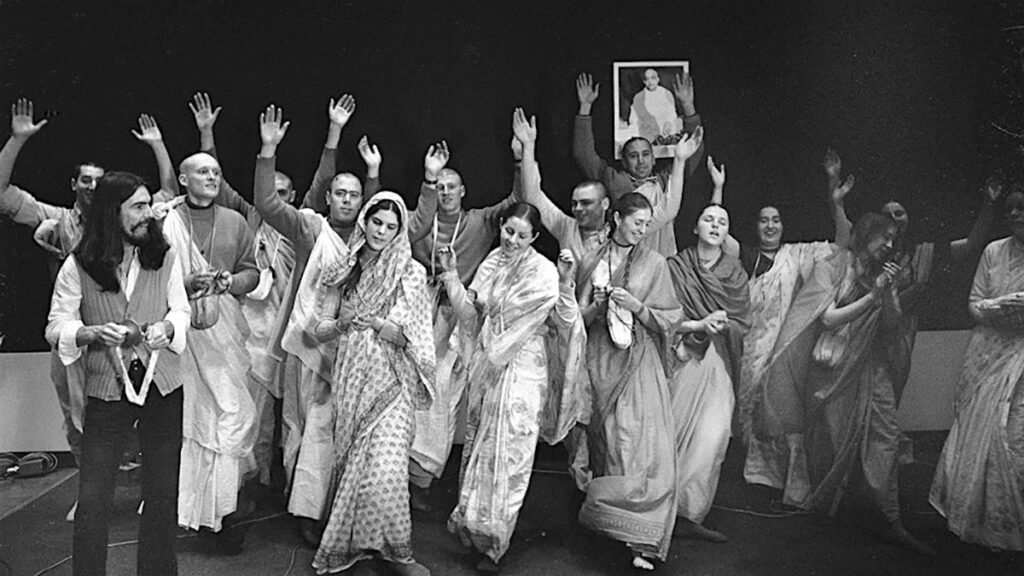
Attracted by their sincerity and dedication to a life of devotion, George invited them to record the Hare Krishna mantra at Apple Studios. The recording was released in 1969 and to everyone’s surprise (not least the Apple Records accountants), it became a top ten hit, attracting listeners with its spiritual message broadcast on radios and televisions across Europe and America. For the first time in history, an ancient spiritual song had gone pop.

A Global Hit

From that point on, the mantra circled the globe. In the intervening half-century, the Krishna mantra has been sung at music festivals, chanted in yoga studios, and performed in most countries of the world. And here’s the surprise: the same mantra that uplifted villagers in Bengal five hundred years ago still brings smiles, still stirs hearts, still brings strangers together in song. At a time when the world often feels divided, when joy can feel scarce, with the help of George Harrison’s recording, the Hare Krishna mantra remains what it has been since the dawn of time: a reminder that beneath all differences, the human spirit longs for connection, music, and love.

George Harrison - Kirtan
1970 – London. Krishna devotees record with George Harrison at Apple Studios.

Appreciations

The Mystic Journey of Chaitanya is the book that the world of spirituality has been waiting for. Joshua M. Greene has managed to liberate the story of medieval Indian mystic Chaitanya from the exclusive grip of hagiographers and academics, a story that for five hundred years has been inaccessible to modern audiences due to gaps in language, history, and culture. In this sensitive account, Greene effectively argues that Chaitanya—the avatar for Kali Yuga, the current age of crisis—was not just a spiritual revivalist, but an ecologist, humanitarian, and peacemaker who sought to lead humanity away from environmental destruction and back to the path of dharma—an urgent message, told here with literary appeal.”

Abeer Saha

Curator, National Museum of American History, Smithsonian Institution
5

“There are few books—let’s call them living books—that hold magic in their pages. The Mystic Journey of Chaitanya is one of them. You can almost hear Chaitanya’s ecstatic singing, smell the fragrance of the earth on which he walked, see the colors of the verdant forests, and feel the excitement of the masses who sang with him. As we read, we are touched by his timeless message that beyond lifeless materialism and empty religious dogma lies an eternal reality of which we are all a part. Joshua M. Greene has done an amazing job by drawing from various sources—traditional, modern, academic, folkloric—to create a fascinating picture of the Golden Avatar that enlivens and inspires with his timeless message.”

Sachinandana Swami, Gaudiya Vaishnava guru

author, Bhagavad Gita (German translation and commentary)
5

“In this splendid study, Greene envisions history as much as narrates it, employing a historical imagination that most historians would fail to achieve. In Greene’s work Chaitanya emerges life-like, in all his dramatic possibilities, immanent more than distant—a creative and persuasive blending of fact and faith and a treat for scholar and devotee alike.”

Amiya P. Sen

historian and author
4

“Over the past five hundred years, there have been many hagiographies of Chaitanya, and in the past century, there have also been scholarly studies of Chaitanya’s extraordinary life and teachings. The Mystic Journey of Chaitanya stands in a class of its own. This book combines the power of traditional narrative with the insights of historical scholarship to give us something unlike any previous rendition of Chaitanya’s life. Joshua M. Greene brings to life sixteenth-century India, gives us a front-row seat to the gripping events that unfolded in Chaitanya’s presence and draws us in the minds and hearts of his contemporaries. Greene does all this while never losing sight of what Chaitanya’s story means for us in the twenty-first century. This is a book that stays with you long after you have read it.”

Dr. Ravi M. Gupta

Charles Redd Chair of Religious Studies, Utah State University
5

“Greene retells the original Chaitanya narrative for readers unfamiliar with this period in history. Staying true to the story and respectful of the tradition from which it arises, he manages to convey the life of the Golden Avatar in a way that nonbelievers will appreciate. If you are someone seeking entrance into one of the most enduring tales that mystic India has to offer, this is the book for you.”

Steven J. Rosen

Author, "Chaitanyology"
founding editor, Journal of Vaishnava Studies
5

“In this absorbing biography of Lord Sri Chaitanya, readers gain insight into the transformative moment when the joyful singing of Krishna’s names began its journey around the world. For more than 500 years, followers have devoted themselves to perpetuating memory of that historic time as experienced by our ancestor, Lord Sri Nityananda Prabhu. No respectable account of Sri Chaitanya can be written without his blessings, and this moving biography has them. It is a magical account and a fitting introduction to one of the greatest spiritual dignitaries the world has ever known.”

Prabhupad Nitya Gopal Goswami, Acharya

14th generation descendent of Lord Sri Nityananda Prabhu
5

“Those of us who have dedicated our lives to preserving and perpetuating sacred sound know Chaitanya as the pioneer of kirtan culture. He was also a child prodigy, a renowned educator, a son, a husband, and later in life a lover of the Divine whose ecstasies are unmatched in mystic writings. Joshua M. Greene has written a beautiful, poignant, warmly personal biography. I loved every page.”

Jai Uttal

Grammy-Nominated kirtan vocalist
5

“Great teachers such as Chaitanya shine like the sun on everyone. He taught that chanting the holy names was the most effective way to create a sacred, loving space between one and all. We are in deep need of that space today, in need of knowing we are capable of loving and worthy of being loved. This biography achieves something wonderful: it brings readers inside the experience of being with him, inside that sacred space where they can feel their hearts open in the sunlight of true love.”

Krishna Das

Grammy-nominated new age vocalist
5

“To read about the lives of the avatars and saints is to have satsang, association, of enlightened minds. Author Joshua M. Greene offers us this rare opportunity in The Mystic Journey of Chaitanya, the sixteenth century spiritual activist and revolutionary who took to the streets to foster social action through ecstatic dance and soulful singing. This moving account of his life inspires us to also become living instruments of reform in the world. This book nourishes the soul and awakens your deepest, inner-most desires. Read, and be inspired.”

Sharon Gannon

co-founder, Jivamukti Yoga
5

“Joshua M. Greene presents us with an easy-to-read devotional literary narrative recounting the life of Chaitanya, the sixteenth-century saint, who founded the Gaudiya Vaishnavism movement. Greene’s biography is accessible, using his storytelling skills to capture with deep feeling the movement’s ideal of chanting the holy name to awaken the self.”

Alan Brill

Cooperman/Ross Chair of Jewish-Christian studies, Seton Hall University
author, "Rabbi on the Ganges: A Jewish-Hindu Encounter"
5

“Chaitanya comes to life in this remarkable narrative: his spiritual realization, his teachings, his relations with family and devotees, and his mission to spread sankirtan far and wide. His story unfolds with vivid reality as he and his companions move through the setting of sixteenth-century India. Its people of city and country, its great temples and devotional life, and its thrilling natural beauty are all portrayed in dense, glowing detail. Subsequent history and the author’s own reflections add welcome enhancements. Compelling, richly rewarding and illumining!”

Kusumita P. Pedersen

Professor Emerita of Religious Studies, St. Francis College
5