Knowledge Up and Down

Rethinking The Bhagavad Gita

Knowledge Up and Down

In an era of data and proof, we trust what can be observed, measured, and verified. It’s a habit born of science and one that has served us well. Reason and empiricism have built the modern world, from aspirin to space travel. Yet data and proof are also promoted as the boundary of what we can know. Everything outside their reach such as intuition, revelation, inspiration, is dismissed as poetry or superstition.

The Bhagavad Gita invites us to reconsider that boundary. In the Gita’s fourth chapter (4.1-3), Krishna tells his warrior-disciple Arjuna that he first taught the science of yoga to the solar king, who passed it down through generations until it was lost and now, through Arjuna, revived. Followers of the tradition embrace this description as historic fact. Others treat such imagery as mythic embroidery, but even then, the story carries a deeper meaning, one that is critical to the search for knowledge.

The Gita describes two currents of knowing: the ascending path, where knowledge arises from observation and reason; and the descending path, where knowledge enters consciousness as revelation. The ascending path (aroha-pantha) builds from experience upward. It is how science works, and it remains civilization’s best defense against chaos, since rational inquiry protects us from dogma and wishful thinking. Still, even the sharpest intellect can mislead. Perception is partial, memory selective, emotion intrusive. We often see only what we are prepared to see. Reason itself is shaped by assumption and desire.

At those limits, another way of knowing appears. The descending path (avaroha-pantha) suggests that truth is not only constructed by the mind but can also be received by it. This is not blind belief or divine dictation. It is knowledge that comes to us, rather than knowledge that is assembled by us, what philosopher Jean Gebser called the transrational: understanding that includes reason yet also transcends it.

We experience such descending knowledge all the time. When a teacher explains something that we could never have deduced alone, that is descending knowledge. When an artist is inspired by an image that came unbidden, when a small flower triggers visions of a majestic natural world, or a scientist sees the solution to a problem in a flash of insight, such moments feel given, not earned. We admit that such knowledge approaches revelation, though the word may make us uneasy.

To receive knowledge in this way requires humility: a willingness to see intellect as a doorway rather than the whole house. It requires at least the willingness to consider that consciousness may be more than a by-product of neurons; and that when we know something, it may be the result of something more than neurological functions. There are current theories of mind, stripped of mysticism, that hint at such a possibility, in particular that self-awareness may be more than the output of particles and forces. Self-awareness may also be a separate and essential feature of reality, waiting to be recognized.

Seen through that lens, Krishna’s statement that he spoke the Gita “at the dawn of time” can be understood as more than ancient cosmology. It can be understood as a metaphor for consciousness itself: the proposal that awareness precedes intellect, that knowing existed before any individual knower. The “solar king” becomes more than a Puranic ruler; he becomes the luminous principle of awareness through which knowledge is first received.

Both paths, ascending and descending, are essential. Without the ascending path of analysis, revelation degenerates into blind faith, and without the descending path of receptivity, reason becomes sterile. Knowledge ascends through effort and descends through grace. Together, they sustain a fuller vision of truth.

In an age where information eclipses reflection, this balance is worth remembering. The challenge before us is not to choose between reason and revelation, but to keep both alive, to sustain the rigor that tests what we know and the openness that welcomes what we cannot prove.

Only then does knowledge become wisdom.

Voltaire

Enemy of the Good

I have a confession to make. After teaching the Bhagavad Gita for nearly a half-century, I rarely know if my classes make any practical difference to anyone. Then this happened.

A recent Zoom session drew about twenty participants from different parts of the world. The theme was “perfection”—in Sanskrit purna or “complete” and “without defect”—and right from the start, there was broad agreement that perfection was not a very appealing concept. It felt oppressive. The notion of somehow rising above all mistakes and failures was a fantasy, more discouraging than inspiring.

The Gita does point toward something beyond imperfection. The atma, or eternal self, is perfect in the sense that it is not made of matter, not subject to decay or death. Still, the imperfect material world is the only reality most of us know. And in this world, striving for perfection—or even for just becoming better—can feel like chasing an ever-receding horizon.

It was in this context that one participant, a counselor from Lebanon, spoke up. She works with refugee families, many of whom come from cultures where violence is so pervasive, abuse of children is considered normal and routine. She described how one family punished their child for a small infraction by locking her in an attic for days. Another family punished their son for minor misbehavior by burning him with coals. The counselor’s voice cracked as she described what she had witnessed.

In a voice barely audible, she said, “I find myself having to advise the parents that instead of locking their daughter away, ‘why don’t you just hit her with a soft slipper?’ Or to the other family, ‘Try slapping your child instead of burning him.’ It’s horrible, the things I have to tell them, but these are the only alternatives they might consider. Sometimes, doing less harm is the only way to make any progress—and that’s why these Gita discussions help me so much. Arjuna did not want to fight, but he was forced to compromise, so he fought but as humanely as possible, without any intention of prolonging pain or suffering. The world we live in forces us into such situations. Sometimes all we can do is choose to do less harm. Studying the Gita has helped me live with what I have to do. So, I thank you.”

Her confession made dramatically clear that values and vocabulary in the Gita—terms such as karma, dharma, gunas, kleshas—are not idealized abstractions but the real grit of human life, where moral clarity is not always obvious, and perfection is an impossible dream.

As the session drew to a close, we all agreed: the Gita does not insist that we become flawless, only that we strive for progress and that we act with realistic expectations. As the French philosopher Voltaire (1694-1778) put it, “Do not allow the perfect to become the enemy of the good.” Perfect, purna as defined in the Gita, means making a perfectly heartfelt effort—however imperfect it may be.

The counselor’s stories reminded us that incremental progress is the only kind, and that doing good, even a little good, is the perfect way to keep a light burning in an often very dark world.

____

Joshua M. Greene (Yogesvara dasa) is author of Gita Wisdom: An Introduction to India’s Essential Yoga Text. His next book is Golden Avatar (Mandala 2027) about the life and teachings of Sri Chaitanya (1486-1533).

Yoga and Oil

Yoga and Oil

An ancient practice offers surprising insights.

Despite warnings over environmental consequences, oil consumption in the U.S. is nearing historic highs, and efforts to create energy-efficient alternatives have dropped. Yoga culture has something to say about the reversal in direction, and to understand how these seemingly unrelated fields intersect, let’s put our present moment in historic perspective.


How We Got Here

A century ago, German sociologist Max Weber described that prior to the Industrial Revolution, pursuit of wealth was considered a mortal sin and condemned by organized religion. Humility and simplicity ranked higher as Christian ideals than wealth and acquisition.

Encouraged first by Renaissance notions of unlimited human potential, then by explosive developments in communications and transportation technology, those ideals switched places. By this new formulation, hard work and resultant wealth became the real test of piety, and no industry embodied this shift more vividly than oil.

John D. Rockefeller, whose company, Standard Oil, was the most powerful corporation of its day, regarded petroleum as “the bountiful gift of the Creator” and used his fabulous wealth to build churches, endow Christian universities, and underwrite early televangelist ministries. By his reckoning, fossil fuel was not merely a natural resource, it was the sacred link between humans and their Maker. By the 1920s, the religious work ethic was firmly established. Diligent labor would lead to prosperity, and prosperity was proof that God was pleased.

Nature, in this formulation, was an endless resource to be exploited in the pursuit of profits. With grim foresight, Weber predicted that the system would endure “until the last ton of fossil fuel has been consumed.” A century later, his words seem eerily prophetic.


The Trap of More

Soon, however, the theological part of the formula dropped away. What need is there any longer for God, asked the wealthy, since hard work alone has proven itself sufficient for achieving prosperity?

What sustained that ethic, and what still sustains it, was the assumption that progress meant producing more, consuming more, and it is here that yoga culture offers an important corrective. There is evidence of yoga in India dating back at least six thousand years, and from its inception, yoga’s central proposition has been that there is a self beyond matter. Of course, that idea in isolation does not constitute a position on the environment. On its own, yoga does not clean rivers or vote down oil pipelines. But it does suggest that progress can be measured differently—not only in profit margins and energy output but in steadiness, awareness, and restraint.

Most of us don’t sit in the boardrooms where energy futures are decided. We make smaller choices, in how we spend, consume, and live. Modest choices, yes, but cultures are built out of them. The ethic of endless production was not revealed on stone tablets; it was assembled from human decisions. And it can be disassembled the same way.


What Yoga Offers

Yoga culture does not promise redemption. It doesn’t exempt us from the political struggle over energy and the environment. But it does suggest that our sense of wealth and progress is not inevitable, and that redefining those terms is possible. It steadies us when the news tempts us to despair. It keeps alive the idea that prosperity isn’t only about what we take from the earth but also about what we recover from ourselves.

That may sound modest, but modest shifts in definition can change civilizations. The work ethic that linked wealth with divine favor remade the modern world. A culture that measures prosperity not by accumulation but by awareness could do the same.

Yoga culture doesn’t offer easy fixes. What it offers is a way to begin again, to act with clarity, and to remember that change is possible. Each of us can carry that steadiness into our families, our communities, and our work. And if enough of us do, even the largest systems can shift.

Yoga suggests that real prosperity lies in discovering forms of progress that enrich us inwardly, while leaving the world around us whole. At stake is how we have come to measure prosperity itself, and whether a different measure might point us toward something more lasting.

Bhakti Books

You and Bhakti: A Reading List

A friend recently told me her yoga teacher ended class by saying, “Bhakti means self-love.” I winced. No, it doesn’t.

In an age when everything spiritual gets flattened into self-care, we’ve managed to turn one of India’s most radical, world-changing ideas into an Instagram caption. Bhakti—love offered to Krishna, the Supreme Person—has nothing to do with narcissism dressed up as healing. It’s about re-ordering the heart so that love stops orbiting the ego and starts revolving around something greater.

And yet, the confusion makes sense. Over the past century, Bhakti’s deep currents, its theology, poetry, and discipline, have been repackaged for modern consumption, much like Buddhist meditation before it was reduced to feeling good, managing stress, or “manifesting abundance.” Bhakti was never meant to be stress therapy, although that may be a secondary benefit. It was meant to be a revolution of consciousness.

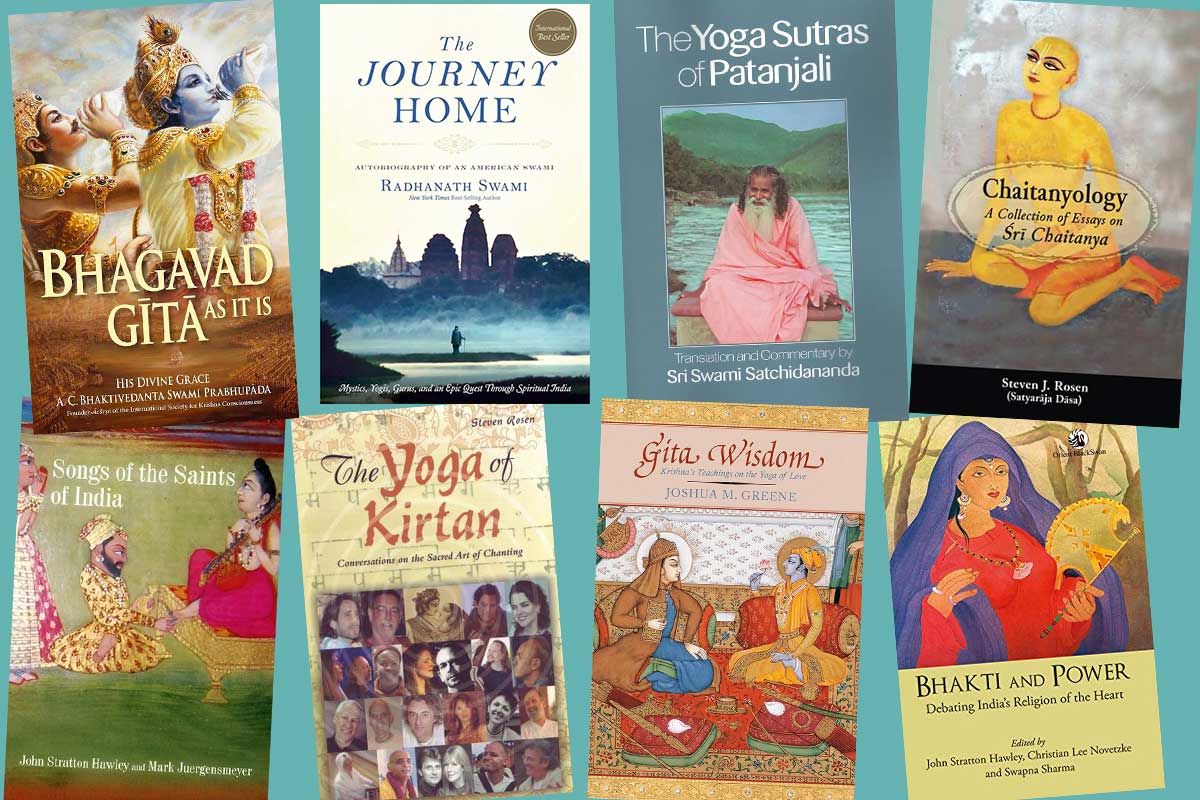
So the teacher in me thought it might be time for a little required reading. The following are books for anyone who has ever wondered: What is Bhakti Yoga? How did an ecstatic spiritual movement that began in medieval India become a playlist on Spotify and a slogan on a T-shirt? How does Bhakti, devotion, interact with reason and social conscience?

Here’s a reading list that can help answer those questions. Some titles explore Bhakti’s historical roots. Others trace its evolution through colonial India into the modern West. A few offer contemporary reinterpretations that restore its philosophical depth.

You don’t need to read all of them. Start with the one that calls to you, whether you’re drawn to sacred poetry, historical context, or spiritual practice. I promise, after reading even one, you’ll never again mistake Bhakti for “just being nice.”

1. Bhagavad Gita As It Is
By A.C. Bhaktivedanta Swami Prabhupada
What you will learn: The Gita is the philosophical root of Bhakti Yoga, a dialogue between Krishna and his warrior-disciple Arjuna that redefines action, duty, and love. Bhaktivedanta Swami’s translation and commentary restore the text’s devotional core, which many modern versions gloss over.
The payoff: You will discover how the Gita’s central teaching, selfless action in loving service, turns ordinary life into a sacred offering.


2. The Journey Home

By Radhanath Swami
What you will learn: A modern memoir tracing an American seeker’s path from the 1970s counterculture to deep immersion in Bhakti practice.
The payoff: Proof that Bhakti can thrive in the modern world—not as nostalgia for the East, but as a universal language of love and service.


3. The Yoga Sutras of Patanjali

Translated and introduced by Edwin Bryant
What you will learn: In this edition of the classical text that shaped yogic philosophy long before the modern wellness era, Bryant’s translation highlights the devotional threads often neglected in secular readings of the text.
The payoff: Bhakti (devotion) and Jnana (study, knowledge) were never rivals. The sages saw love and clarity as twin paths toward the same realization.


4. Chaitanyology: Writings on the Transformative Teachings of Sri Chaitanya Mahaprabhu
By Steven J. Rosen
What you will learn: A lucid, contemporary exploration of Chaitanya Mahaprabhu’s philosophy of bhakti, divine love, drawing from scripture, music, and modern scholarship. Rosen unpacks how Chaitanya’s vision of ecstatic devotion shaped Vaishnava theology and still informs global Bhakti culture today.
The payoff: A bridge between past and present—showing how a 16th-century saint’s message of humility and joy continues to speak to seekers living in a fractured world.


5. Songs of the Saints of India
Translated by John Stratton Hawley and Mark Juergensmeyer
What you will learn: Selections from the great medieval poet-saints, including Mirabai, Tukaram, Surdas, and Kabir, who sang of divine love in vernacular tongues, defying caste and convention.
The payoff: Their verses are as raw and urgent as the blues. You will feel Bhakti as both social protest and mystical awakening.


6. The Yoga of Kirtan
By Steven J. Rosen
What you will learn: A collection of in-depth interviews with leading kirtan artists such as Krishna Das and Jai Uttal, revealing the personal histories, philosophies, and experiences behind Bhakti chants.
The payoff: This book restores the soul to what has too often become performance. It’s a living portrait of Bhakti practice as sound, surrender, and shared joy.


7. Gita Wisdom: An Introduction to India’s Essential Yoga Text
By Joshua M. Greene
What you will learn: A brief modern retelling of the Bhagavad Gita in contemporary language, exploring how its ancient message of selfless love can guide modern life.
The payoff: The Gita’s teachings on Bhakti aren’t about escaping the world; they are about elevating it and turning daily duty into sacred offering, and love into a practical philosophy.


8. Bhakti and Power: Debating India’s Religion of the Heart
Edited by John Stratton Hawley
What you will learn: Scholars debate whether Bhakti was a challenge to power or a tool of it—an uncomfortable but essential conversation.
The payoff: This collection reminds us that love, when authentic, is never sentimental. It is disruptive, demanding, and socially transformative.


Your assignment
Pick one book that speaks to you. Read it not as a spectator but as a participant. For extra credit, read two, and you may find yourself doing something quietly radical in the year to come: loving the world not for what it gives you, but for what you can give back.

rotten at apple studios

Rotten At Apple Studios

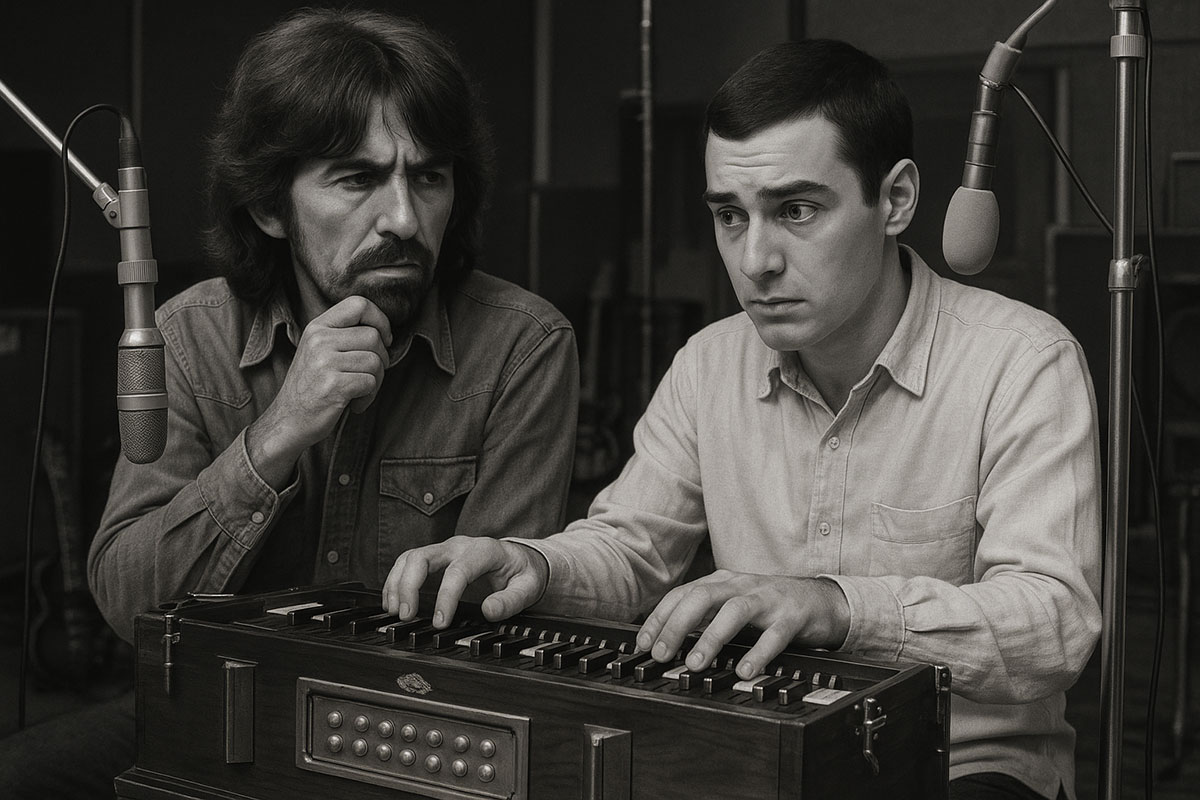
Back in 1970, at age twenty, I left the Sorbonne University in Paris where I had been studying literature and began studying the Bhagavad Gita at the Krishna temple in London. It was also the year George’s single, “My Sweet Lord,” became the most successful solo release by any of the Beatles. The recording reflected his growing interest in mantras and meditation, and the week I arrived he was producing an album of Indian devotional songs with the London Krishna devotees. I had the good karma to be invited to play harmonium during recording sessions at Apple Studios. The harmonium was a small hand-pumped keyboard instrument, and it felt close enough to playing an organ that I was able to pick up the notes and jump in.

During sessions, George’s pure perception of the devotional spirit beneath India’s traditional music affected us all. I, on the other hand, was stuck in rock-n-roll cliches. At one point during an introductory solo to the song “Govinda Jaya Jaya,” I let loose with an embellished riff. George calmly raised an eyebrow and gave me a look that silently said, “Really?”

It took me a minute, but his meaning became painfully clear. We were recording a prayer. This wasn’t the time for showmanship. We were there to serve the sacredness of the mantra. That was a clarifying moment for me, in which George conveyed, with just a look, that less is often more, that simplicity can be more eloquent than elaborate display, and that a good thought is best communicated through refined expression, particularly if one is recording sacred music.

That was more than fifty years ago, and I’m still learning those important lessons. For George, humility in service to Govinda, Krishna, was inseparable from who he was and woven into the very fabric of his being.

Apocalypse

Fun Books for the End Time

Two Bestsellers with Unhappily-Ever-After Endings

As if life weren’t dramatic enough, I’ve been reading novels that predict humanity may not recover from its abuse of the natural world.

Margaret Atwood’s Oryx and Crake imagines a near-future wasteland created by genetic experiments gone wrong. In an interview, Atwood explained the book’s eerie hybrids and collapsing ecosystems as a warning: “What if we continue down the road we’re already on? How slippery is the slope? Who’s got the will to stop us?”

For decades Atwood clipped bizarre items from the back pages of newspapers. What seemed paranoid fantasy then, she noted, often became reality. One telling example: she finished the book in the shadow of 9/11. “It’s unsettling when you’re writing about a fictional catastrophe and then a real one happens. I thought maybe I should turn to gardening books. But what use are gardening books in a world without gardens or books?”

Cormac McCarthy’s The Road strips the apocalypse bare. A father and son wander a nuclear-winter landscape, dodging cannibal gangs, scavenging for scraps, urging each other not to lie down and die. The prose is hypnotic, the mood ash gray. Yet beneath the bleakness, McCarthy insists that love can redeem even when redemption seems impossible.

Both novels echo earlier warnings—particularly in George Orwells’ 1984 novel Brave New World—that something “false within” is driving humanity to ruin. The Bhagavad Gita diagnosed the same disease millennia ago: “The demoniac say this world has no God in control, that its main moving force is sex, and following such conclusions they engage in unbeneficial, horrible work that can destroy the world. ‘So much is mine now,’ they tell themselves, ‘and it will increase in times to come.’”

Unlike novels which often offer no way out, the Gita provides a frame of consciousness that transcends borders and politics. Bhakti—the vision of all life as sacred—has the potential to be a practical program for social reform, but it will require compassion, respect for nature, and concern for the wellbeing of all. Disasters may come, but in a culture guided by devotion, they need not be final. A simple acknowledgment of life’s sanctity opens access to unseen resources and creative ideas for restoration. Even a hint of humility, the Gita suggests, can nudge humanity and the natural world back on track.

The Gita may lack the page-turning thrills of apocalypse novels (for that, see its parent epic, the Mahabharata). But for readers who want to close a book feeling more hopeful than horrified, the Gita is the ultimate survival manual.

Markets Are Up

The Markets Are Up—but My Spirits Are Down

One person’s struggle with cable news and the search for deeper meaning.

Most mornings I make the same mistake: I turn on cable news. I know. Bad idea. Five stories about how the world is going to hell, then, a moment later, a cheerful anchor tells me the markets are up, as though that’s supposed to lift my spirits. But it doesn’t. I check my retirement account, see my few dollars growing, and still feel a kind of hollowness. If the markets are up, why do I feel so down?

The Bhagavad Gita has a word for this restlessness: kama, a Sanskrit term often translated as desire, but a better definition would be longings born of ego. And that doesn’t just mean greed. I’ve caught myself chasing “good” desires, too: publishing more, teaching more, doing more. Noble pursuits, maybe, but still ego driven. The Gita’s warning is that even these polished desires keep us circling in the same karmic loop.

When Work Became Worship
I grew up hearing that hard work was a virtue. My postwar generation has lived by that creed, but the story is older than us baby-boomers. For centuries, the religious establishment was suspicious of wealth. “It is easier for a camel to pass through the eye of a needle than for a rich man to enter Heaven,” the Bible warned. Money was considered dangerous, even corrupting.
Then came the Industrial Revolution. Suddenly wealth looked like divine favor. John D. Rockefeller, who built Standard Oil, called petroleum “the bountiful gift of the great Creator.” He poured his fortune into universities and ministries. Piety became measurable in productivity.

Before long, the God part slipped away—work hard and prosper, whether He exists or not—and it’s a credo that still shapes the way many people measure their days.

The Cage We Live In
The French sociologist Max Weber warned back in 1905 that capitalism’s “iron cage” would trap us all “until the last ton of fossil fuel has been consumed.” Not a bad prediction, yet more than a century later, consumer culture has us buying as though natural resources were infinite.

Behind the simple math of how much-longer-can-this-go-on lies something darker. I became vegan years ago after seeing what factory farms do to animals: living beings slaughtered and redefined as units of protein, engineered for efficiency. It was a shock to realize how much suffering could be hidden behind consumption and supermarket packaging. That, too, is kama: “progress” so effectively disguised that life itself becomes commodified.

A Different Measure
The Gita doesn’t tell us to walk away from our life. It doesn’t scold us for wanting things. It simply asks: is this desire freeing you or binding you? That’s a question I try to ask myself these days when I’m about to buy, scroll, or react. Am I moving from clarity or from compulsion? In the Gita, the warrior Arjuna still goes to war. Action is inevitable. The difference is that he acts awake, not asleep.

So What Now?
Markets will rise and fall. What matters is whether we rise and fall with them. Here’s a modest exercise you might find useful. Before the next impulse purchase, ask yourself, who is choosing? Is it the real me, or a me fabricated by the consumer culture around me? On a larger scale, we can push for accountability from industries that profit off our desires while depleting the planet. On a more immediate scale, we can push for the same in ourselves.

The Gita’s teaching is quite practical: act but act awake. And maybe turn off the television.

baa shev tov

Tell The Story

Friends,

I don’t know about you, but I’m not an enlightened yogi, and I don’t think any of the people I’ve met in Bhagavad Gita classes are either. None of them can shoot fire from their eyes, make an apple manifest from thin air, or float. What they can do is melt my heart. With few exceptions, people attending these classes are beautiful souls, hungry for joy, and fumbling at the lock of transcendence with keys that don’t quite fit. But they keep coming. I’ve often wondered why. Then I came across the following story told by the late Holocaust survivor Elie Wiesel, and it gave me a clue.

Israel ben Eliezer, known as the Baal Shem Tov (c.1700-1760), the healer and mystic who founded Hasidic Judaism, looked out at the world and saw disaster stalking everywhere. So he went into the forest, found the place where rituals were performed, lit a sacred fire, recited mystic prayers—and the disaster disappeared.

In the following generation, disaster again rose its head. But the Baal Shem Tov had passed away, and his disciples did not know the location of the place of rituals. They only knew how to build the sacred fire and recite the mystic prayers. But it was enough, and again disaster was avoided.

Then came the next generation, and when disaster again threatened, followers knew neither the location of rituals nor how to light a sacred fire. They knew only the mystic prayers. But once again, it was enough, and disaster dissolved away.

Then came yet another generation, and this generation knew nothing of sacred places, healing fires, or mystic prayers. All they knew was the story of the Baal Shem Tov and how the generations after him had worked with whatever tools they had to heal the world.

So, that was the story they told. They told it to one another, to others, and the people listened to it and passed it along. Words—just words. But the words were enough to inspire a new generation, and by the telling of the story, once again disaster was averted.

And us? We’re not mystic healers. We’re not even exceptional students. We are the tail end of a long inheritance, frayed, fragile, pieces missing. But we can tell the story and pass it on. We can tell it wherever we are, in classrooms, in kitchens, in parks or any place where people gather, wherever ears are open.

And when the story is told from the heart, something moves in the hearts of others. The mystery rises from obscurity, and the world shifts a little, and maybe, just maybe, disaster steps back.

Don’t wait to be holy. No need. Just keep coming, and we will regale one another with stories from long ago and far away—or from yesterday and next door. Everyone is the vehicle for a powerful story. It just needs to be told from the heart.

Tell your story. That’s how we fight disaster. That’s how we survive and grow.

Fondly,
Yogesvara

on the beach

On The Beach

In the 1970s, during one of my first visits to India, I found myself standing on the edge of the world. Or so it seemed. It was late one night, and I was walking on Juhu beach, on the outskirts of Bombay, gazing up. This was at a time when the city was still developing into the nation’s commercial hub, and there were as yet no nighttime lights behind me from 24-hour shops or factories, nothing to disturb the darkness. In that majestic canvas where the ocean met the sky, there was no telling where the world ended or the heavens began. The waves lapping the beach sounded like gentle breathing, whoosh, sigh, whoosh, sigh. The landscape before me was beautiful, hypnotic, and stretched on forever.

In that moment, something happened that I can only describe as mystical. I felt myself lifted off the sand and hurled through the blackness overhead. I wasn’t scared. It was exhilarating to be weightless, untethered from the earth, thrilling to leave troubles behind and soar outward, liberated from flesh and bones and all thought. I was no longer concerned about anything. I became someone else, someone free and infinite. I don’t know how long the experience lasted, but the memory has endured to this day.

Is Krishna real? Are we, as 16th century avatar and saint Chaitanya taught, sparks of Krishna’s fire, eternal beings, free and infinite, who shine on long after this life has crumbled to dust? If we consider the suffering and injustice that surrounds us, the sadness and broken lives, the idea that we are divine beings doesn’t make much sense. Human history is not uplifting. It’s tragic. And from a purely rational assessment, there isn’t much evidence of a benign, beneficent creator or a nonmaterial self that survives death. Still, after more than a half-century of chanting mantras, of self-reflection and study, I find myself holding to that conviction—not because of any solid, empiric evidence, but because I know how it makes me feel: energized, hopeful, a glass-half-full feeling. It is the kind of universe I choose to live in.

My children are extraordinarily bright, and they will come to their own conclusions, but they can only do that if they have a choice, if a world in which people love one another as sacred beings is an option. Maybe I’m wrong. Maybe humanity is condemned to its physical, biological, evolutionary impulses. Maybe people who pigeonhole Krishna as nothing more than a metaphor have reason to think the way they do. For myself, he’s quite real, and even if judged as only a metaphor, he is no doubt the most beautiful metaphor, an irresistible metaphor, one that inspires us to be more than we have been.

If you ever find yourself someplace like that beach in Juhu, just you and the universe, take a moment to look up and fly away. It’s a helluva a ride.