Tantalus

Tantalus

“Embodied souls can acclimate to a life of discipline, even if taste for worldly pleasures persists. By knowing a higher taste, all other interests abate.” 
Bhagavad Gita 2.59

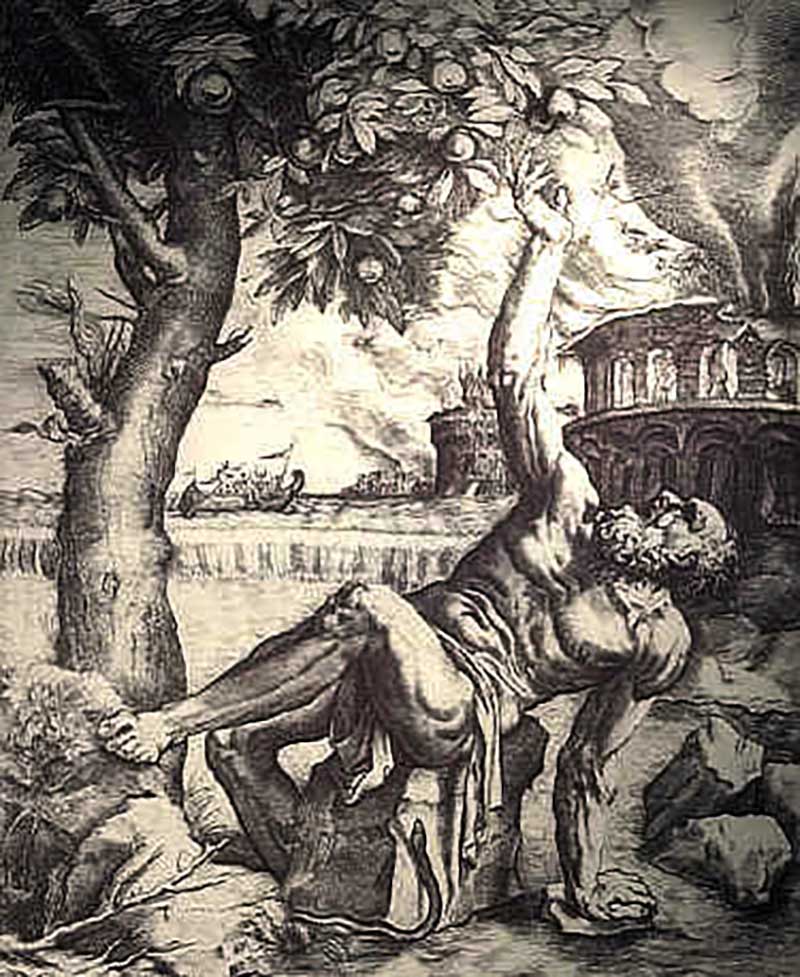
For his acts of greed, Zeus’s mortal son, Tantalus, was made to stand in a pool of water beneath a fruit tree. Whenever Tantalus reached out, the branches rose away. Whenever he bent to drink, the water receded—cursed to being forever “tantalized.” This verse from the Gita reminds us that however drawn we may be to the “fruits” of an illusory world, nothing compares to the joys of a yogic life of devotion to God.

To develop that “higher taste,” the Sanskrit texts recommend chanting the maha-mantra: Hare Krishna, Hare Krishna, Krishna Krishna, Hare Hare, Hare Rama, Hare Rama, Rama, Rama, Hare Hare. In the company of righteous men and women cultivating a “higher taste,” here’s a satisfying fruit within our grasp.  

hazy lake

Gita Wisdom

“Of secret things, I am silence.” 
Bhagavad Gita 10.38

If Krishna describes himself as silence among secret things, it is not because he hides himself from us; rather, it is because he cannot be seen with material eyes. The alternative way of seeing divinity is through eyes of love. The great avatar Chaitanya, in his ecstatic love for Krishna, the supreme being, saw him everywhere, in everything. He would, for instance, embrace blue-bark tamala trees, as their color reminded him of blue-hued Krishna.  

Develop your spiritual vision by starting each day with activities that are materially “silent” such as meditation, deep breathing, and study of the Gita. Chaitanya recommended chanting Krishna’s names. How long you chant is not as important as how intently you chant. If all you can do is five focused minutes, that’s fine, but do it every day.

Consistency is the key to success in spiritual practices.

Winged Victory

Winged Victory

“Know truly: that which pervades the body does not die. Nothing can destroy the imperishable soul.”
Bhagavad Gita 2.17

The Nike of Samothrace, ancient Greece’s goddess of victory, is celebrated in this renowned sculpture known as “Winged Victory.” She embodies not only ideal beauty but action and triumph, a fusion of external participation and internal stillness–an apt metaphor for verse 2.17 of the Bhagavad Gita.

The sacred Gita informs us that as eternal beings we, too, have the potential for victorious action in the world. Life’s traumas cannot hold us down. We are their witness, not their victim. The atma or imperishable consciousness is untouched by external stress. We succumb to stress when we mistakenly identify with the empiric world. The Gita offers this reassurance: you, the immortal self, energizing the physical body and subtle mind, share Krishna’s qualities of eternity, self-awareness, and bliss. Like sparks from a fire, we possess the qualities of the fire: beautiful, strong.

Be like Winged Victory. Cultivate knowledge of your inner divinity through healthy habits, good company, and daily meditation. Become an agent of change, triumphant yet calm and still. Here’s one simple way: each morning for five minutes, chant the sacred mantra Hare Krishna, Hare Krishna, Krishna Krishna, Hare Hare, Hare Rama, Hare Rama, Rama Rama, Hare Hare. Experience divinity for yourself.

The Thinker

The Mind: Enemy and Friend

Completed in 1902, the six-foot-tall sculpture “The Thinker” by August Rodin portrays Italian poet Dante Alighieri in front of the gates of hell, pondering “The Divine Comedy,” his three-part epic journey through hell, purgatory, and heaven. Guided first by the Roman poet Virgil and later by his idealized beloved Beatrice, Dante moves from despair and sin toward enlightenment and divine union.

The poem serves as both a spiritual allegory of the soul’s ascent to God and a vivid moral commentary on human vice, virtue, and the structure of the universe. Rodin chose to depict Dante as a man mentally tormented by these grand meditations.

The Bhagavad Gita reminds us that the mind can also be our best friend. An open mind is the gateway to freedom, as it offers perspectives the fearful mind cannot see. Bengali saint Chaitanya (1486-1533) declared that repeating the Krishna mantra gives the chanter access to the life of an open mind: Hare Krishna, Hare Krishna, Krishna Krishna, Hare Hare / Hare Rama, Hare Rama, Rama Rama, Hare Hare. This simple practice slows the heart rate, brings oxygen to the brain, and permits a calmer, more reasoned assessment of life’s challenges.

Vermeer

Vermeer

“As the soul passes in this body from infancy to youth to old age, at death the soul passes into yet another body. Such changes do not bewilder those of steady mind.” 
Bhagavad Gita 2.13

Woman with a Pearl Necklace
Vermeer (c. 1664)

Dutch master Johannes Vermeer (1632-1675) has painted a girl studying herself in a mirror. The oversized pearl necklace tells us she is an aristocrat, but breeding cannot insulate her from the uncertainty of what she sees. Dressing is an everyday act, yet she seems uncertain what to make of her own reflection. Is this repetitive, predictable image all she is?

Intuitively, we sense more to ourselves than what we perceive. Our immortality lies just below the surface, just beyond the reflection in a mirror. To better grasp the reality beneath everyday appearances, India’s wisdom texts invite us to chant the clarifying mantra Hare Krishna, Hare Krishna, Krishna Krishna, Hare Hare, Hare Rama, Hare Rama, Rama Rama, Hare Hare.

Here’s thought. Find a place where you can keep good company, where you are with others looking to peek behind the mirror at the deeper, permanent self behind the surface of appearances.

A Happy Life

How to Have a Happy and Meaningful Life

According to the Bhagavad Gita


1. Come to Terms with Death

Bhagavad Gita 2.13
“As the embodied soul continually passes, in this body, from boyhood to youth to old age, the soul similarly passes into another body at death. The wise are not bewildered by such change.”
Reflection: Death is not an end but a transition. The Gita teaches that consciousness—the self within—does not perish when the body dies.
Practice Insight: Contemplate impermanence in everyday events, both the sad and the rewarding. When you accept that change will happen, you can cultivate patience and gratitude, and courage will replace fear.


2. Develop a Non-Neurotic Sexual Identity

Bhagavad Gita 7.11
“I am the strength of the strong, devoid of passion and desire. I am sex life which is not contrary to dharma.”
Reflection: Sexual energy is divine when expressed without selfishness or exploitation.
Practice Insight: Take charge of your sexual energy by seeing intimacy as an exchange of trust and respect, not possession. Honor desire by aligning it with care and honesty.


3. Work with Your Unique, Natural Skill Sets

Bhagavad Gita 18.45–46
“By following one’s own nature in work, a person attains perfection. It is better to perform one’s own duty imperfectly than another’s perfectly.”
Reflection: Fulfillment comes from developing one’s innate gifts (svabhava) and serving through them.
Practice Insight: Notice what feels natural and energizing. Let your purpose evolve from your authentic abilities.


4. Live a Zestful, Adventurous Life

Bhagavad Gita 10.36
“I am victory, adventure, the strength of the strong.”
Reflection: The Gita urges us to act with a full heart but without attachment to results.
Practice Insight: Treat life as a sacred adventure. Focus on the excellence of effort, not on outcomes.


5. Behave Empathically Toward Others

Bhagavad Gita 12.13–14
“One who is not envious but a kind friend to all beings… forgiving, peaceful, and content—that person is very dear to Me.”
Reflection: True strength is measured by gentleness. Compassion connects us to the divine in others.
Practice Insight: Before speaking or acting, pause to ask: “Will this relieve suffering or add to it?”


6. Maintain Meaningful Friendships

Bhagavad Gita 13.10-11
“[The wise] cultivate a distaste for the company of the worldly.”
Reflection: Association molds consciousness. Bad company draws the mind to passion and anger, while good company, grounded in devotion, uplifts and steadies the heart.
Practice Insight: Spend time daily in silence or reflection to strengthen the friendship within. It will naturally extend outward.


7. Respond to Beauty

Bhagavad Gita 10.41
“Whatever is beautiful, glorious, or powerful, know that it springs from but a spark of My splendor.”
Reflection: Beauty awakens reverence. To see beauty clearly is to glimpse divinity at play in the world.
Practice Insight: Let moments of beauty—music, light, kindness—be reminders of the sacred nature of all things.


8. Dwell in Some Form of Sacredness

Bhagavad Gita 9.22
“To those who are devoted and worship Me with love, I give the understanding by which they come to Me.”
Reflection: Sacredness is not confined to temples or yoga classes. It is a state of heart aligned with love and purpose.
Practice Insight: Begin and end each day with a moment of gratitude or prayer. When life feels sacred, happiness follows naturally.

quality of bhakti yoga

Discovering Humanity in the Bhagavad Gita

When I first turned to the Bhagavad Gita, I expected a book of commandments—a manual of divine law, moral injunctions, and supernatural assertions. What I found instead was something startlingly human. The Gita’s portrait of an enlightened person is not of a miracle worker or mystic lost in trance, but of someone deeply decent, emotionally balanced, and quietly radiant with goodness.

I had anticipated doctrines: rules for prayer, prescriptions for purity, or threats of punishment. Instead, the Gita offered qualities of character that any of us might aspire to cultivate. The bhakti yogi, or person of devotion, is described (mostly in the 12th chapter, verses 12-20) as:

  • Not envious
  • Friendly
  • Compassionate
  • Without selfish interest
  • Aware of their nonmaterial identity
  • Equal in happiness and distress
  • Tolerant
  • Forgiving
  • Self-controlled
  • Content

Reading these verses, I realized that perhaps “human” is another word for “divine” stripped of its religious trappings. The Gita does not divide the world into saints and sinners. It paints an enlightened being as someone who has learned to meet the turbulence of life with grace. Such a person:

  • Puts no one into difficulty
  • Is not disturbed by others or by fear or anxiety
  • Leads a life that is pure, meticulous, and free from the fever of material results.

Even uncertainty does not shake such self-aware individuals. They are equal to all, indifferent to honor or dishonor, content with modest living, and wise enough to avoid frivolous company.

In these verses, I did not find a god perched beyond the clouds demanding obedience. I found a mirror, one reflecting what we might become when we stop measuring worth by achievement or belief, and start measuring it by peace, humility, and kindness.

The Gita’s enlightened person is not remote from the world but fully present in it, determined to stay on the spiritual path, modest about knowledge, and devoted to serving God by serving others.

Perhaps the real revelation of the Gita is that goodness—steady, quiet, unpretentious goodness—is not merely human. It is the divine wearing a human face.

A suicide, a policeman, and an act of irrational self-sacrifice

My Life for Yours

A suicide, a policeman, and an act of irrational self-sacrifice

The panoramic view from the Nuuanu Pali Lookout on Oahu draws tourists by the busload. From that height, the island a thousand feet below disappears into the sea. The wind howls through the cliffs. It’s beautiful, and, for some, irresistible, a perfect place to die, a quarter mile straight down, the trade winds ready to scatter a body over the Pacific.

One morning, a police cruiser rounded the final bend at the summit. The officer behind the wheel saw a young man on the far side of the guardrail, leaning into the void. Without thinking, he slammed on the brakes, leapt from the car, sprinted across the road, vaulted the barrier, and lunged. His hand caught a sleeve just as the man pitched forward. For a moment, they both hung suspended over nothing. Then gravity kicked in. The officer’s boots scraped for purchase, but it was too late. They were falling together. 

At that instant, the second officer jumped from the cruiser, vaulted the same rail, and caught his partner by the collar. With a tremendous tug, he pulled both men back to solid ground. Tourists screamed. Some ran for help. Others simply wept.

When the chaos subsided and the rescued man was taken to a hospital, a reporter asked the officer why he had done it. Why had he risk everything—his life, his family’s future—for a stranger? Even as a police officer, there was no rule, no law, no duty compelling him to make such a sacrifice. 

The officer paused, then said softly, “I don’t really know. It wasn’t a thought. It was a feeling, that if I didn’t try to save him, I wouldn’t want to live with myself.”


The Impulse Beyond Reason

Such extreme self-sacrifice seems almost alien in our culture, one that places self-preservation before everything else. Who leaps to their death for someone they have never met? It sounds like myth. Indeed, mythologist Joseph Campbell, who lived not far from the Pali cliffs, called the officer’s action “a psychological breakthrough,” meaning a moment when something from his unconscious superseded rational thought. The officer didn’t weigh pros and cons. Some older, deeper impulse moved through him. What was it?

Neuroscience has begun to solve that mystery. Research led by Tania Singer at the Max Planck Institute shows that when people witness another’s suffering, the same regions of the brain light up as when they themselves feel pain. Giacomo Rizzolatti’s team at the University of Parma reached similar conclusions. The implications are startling: our nervous system is built for empathy. We are biologically programmed to feel one another’s lives. 

Frans de Waal, in The Age of Empathy, describes similar moments among primates: monkeys who decline food rather than harm other monkeys, or one monkey cradling another after a fight. The impulse to protect, to comfort, to share pain, seems to be not merely a moral option but part of the very fabric of life. From that view, the officer at the Pali Lookout wasn’t saving a stranger so much as saving a life they both shared. His reflex came from an unconscious recognition that the border between “you” and “me” may be an illusion.

The Thread That Binds

For millennia, wisdom traditions have taught that every being, every life, is woven from the same thread. Buddha called it the Buddha nature: when others suffer, it is part of us that suffers in them. Political systems, economies, and historical events can influence or lessen our tendency for empathic connection, which explains why moments like the one on the Pali Lookout feel so astonishing. They remind us of a part of ourselves that is the antithesis of the world we live in.

“If I didn’t try to save him,” the officer said, “I wouldn’t want to live with myself.” In that simple sentence lies the oldest of moral truths. Sometimes we call it the Golden Rule: Behave toward others as you would have others behave toward you. In the words of the Bhagavad Gita:

They are the mature yogis who
by comparison to themselves
see the equality of all beings
in happiness and distress.
(6.32)
 

Journaling

Hints On Journaling

A Simple Practice for a Clearer Life

When I teach the Bhagavad Gita, I often suggest to students that they keep a journal. Writing down thoughts and reflections deepens awareness. It’s a way of turning vague impressions into practical insight. For those pursuing a spiritual path, journaling becomes a mirror for the inner journey—a way to see the movement of the mind and heart more clearly.

But journaling isn’t just for students of yoga or sacred texts. It’s healthy for anyone. It can calm a restless mind, clarify emotions, and give shape to ideas that might otherwise slip away unnoticed. Psychologist James Pennebaker suggests that expressive writing reduces stress and strengthens emotional resilience. In creative fields, journaling is used to sharpen focus and free the imagination. So whether you’re seeking spiritual growth, peace of mind, or simply a more attentive life, here are a few hints to make journaling immensely rewarding.

1. Keep It Simple
You don’t need ornate notebooks. A spiral pad will do. The essential thing is honesty. Write a few lines each day about what you notice, feel, or remember. Just begin. Simplicity keeps the practice alive.

2. Keep It Private
Your journal is a sanctuary for your unfiltered thought. Guard its privacy. When you know no one else will read it, you can write with freedom and candor.

3. Do It Frequently
Like any practice—yoga, meditation, prayer—journaling grows more powerful with regularity. Daily entries are best, but even two or three times a week can reveal patterns and insights. It’s not how long you write that matters, but how often.

4. Forget Grammar
Spelling, punctuation, and sentence structure are irrelevant. Let the words tumble out. The goal is to record your thoughts, not to impress an editor.

5. Write What You Know
Begin with the day’s events: a conversation, a frustration, a moment of beauty. These can lead to larger understanding. Over time, your journal will become a map of how you see the world—and a record of how your vision changes.

6. Find the Best Time and Place
For some, early morning when the mind is still uncluttered is ideal. Others prefer night, when the day’s impressions settle. Choose a place that invites stillness: a quiet room, a park bench, a sunlit corner. Make it your journaling space.

7. Write for Quantity, Not Quality
Set a timer for ten minutes and write without stopping. Don’t edit, analyze, or reread. The object is flow. You’ll be surprised at the insights that surface when you outrun your inner critic.

8. Try Writing by Hand
Handwriting slows the mind to the rhythm of thought. The physical act of forming letters engages deeper memory and emotion. A handwritten journal also holds greater emotional value than a typed page.

Resources for Going Deeper
If you’d like to cultivate journaling as a daily or spiritual discipline, the following resources are excellent companions:

Books:

  • The Artist’s Way, Julia Cameron’s classic on creativity and morning journaling.
  • Writing Down the Bones, Natalie Goldberg’s Zen approach to writing as mindfulness.
  • Journal to the Self, Kathleen Adams’ guide to journaling for insight and healing.

Final Thought
In Bhagavad Gita terms, journaling is a form of svadhyaya, self-study, one of the essential disciplines of yoga. Over time, the pages you fill become a dialogue between you as seeker and you as the self you seek.

Knowledge Up and Down

Rethinking The Bhagavad Gita

Knowledge Up and Down

In an era of data and proof, we trust what can be observed, measured, and verified. It’s a habit born of science and one that has served us well. Reason and empiricism have built the modern world, from aspirin to space travel. Yet data and proof are also promoted as the boundary of what we can know. Everything outside their reach such as intuition, revelation, inspiration, is dismissed as poetry or superstition.

The Bhagavad Gita invites us to reconsider that boundary. In the Gita’s fourth chapter (4.1-3), Krishna tells his warrior-disciple Arjuna that he first taught the science of yoga to the solar king, who passed it down through generations until it was lost and now, through Arjuna, revived. Followers of the tradition embrace this description as historic fact. Others treat such imagery as mythic embroidery, but even then, the story carries a deeper meaning, one that is critical to the search for knowledge.

The Gita describes two currents of knowing: the ascending path, where knowledge arises from observation and reason; and the descending path, where knowledge enters consciousness as revelation. The ascending path (aroha-pantha) builds from experience upward. It is how science works, and it remains civilization’s best defense against chaos, since rational inquiry protects us from dogma and wishful thinking. Still, even the sharpest intellect can mislead. Perception is partial, memory selective, emotion intrusive. We often see only what we are prepared to see. Reason itself is shaped by assumption and desire.

At those limits, another way of knowing appears. The descending path (avaroha-pantha) suggests that truth is not only constructed by the mind but can also be received by it. This is not blind belief or divine dictation. It is knowledge that comes to us, rather than knowledge that is assembled by us, what philosopher Jean Gebser called the transrational: understanding that includes reason yet also transcends it.

We experience such descending knowledge all the time. When a teacher explains something that we could never have deduced alone, that is descending knowledge. When an artist is inspired by an image that came unbidden, when a small flower triggers visions of a majestic natural world, or a scientist sees the solution to a problem in a flash of insight, such moments feel given, not earned. We admit that such knowledge approaches revelation, though the word may make us uneasy.

To receive knowledge in this way requires humility: a willingness to see intellect as a doorway rather than the whole house. It requires at least the willingness to consider that consciousness may be more than a by-product of neurons; and that when we know something, it may be the result of something more than neurological functions. There are current theories of mind, stripped of mysticism, that hint at such a possibility, in particular that self-awareness may be more than the output of particles and forces. Self-awareness may also be a separate and essential feature of reality, waiting to be recognized.

Seen through that lens, Krishna’s statement that he spoke the Gita “at the dawn of time” can be understood as more than ancient cosmology. It can be understood as a metaphor for consciousness itself: the proposal that awareness precedes intellect, that knowing existed before any individual knower. The “solar king” becomes more than a Puranic ruler; he becomes the luminous principle of awareness through which knowledge is first received.

Both paths, ascending and descending, are essential. Without the ascending path of analysis, revelation degenerates into blind faith, and without the descending path of receptivity, reason becomes sterile. Knowledge ascends through effort and descends through grace. Together, they sustain a fuller vision of truth.

In an age where information eclipses reflection, this balance is worth remembering. The challenge before us is not to choose between reason and revelation, but to keep both alive, to sustain the rigor that tests what we know and the openness that welcomes what we cannot prove.

Only then does knowledge become wisdom.