The Tomb of the Diver

The Tomb Of The Diver

“I am victory and adventure.” 
Sri Krishna in the Bhagavad Gita, 10.36

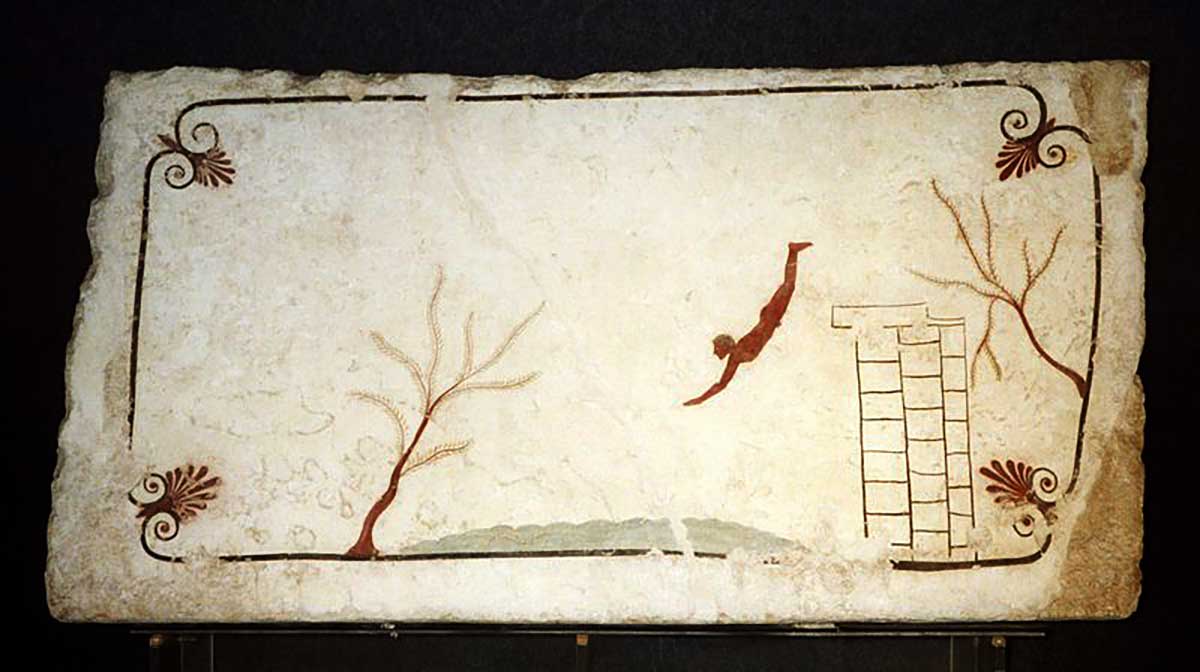
“The Tomb of the Diver” dates from the fifth century BC. This image on an ancient Greek coffin portrays someone who has taken a daring leap and is now suspended in time. The diver is neither on familiar ground nor yet submerged in the water below. He is in a state of perpetual risk. His old life is gone, and the new one has yet to begin.

Taking to the yoga path is like that. The old world is gone, the new one, based on devotional service, lies ahead. To maintain vyavasayatmika-buddhi, steady intelligence, while suspended in this life between worlds, the Bhakti texts recommend chanting Hare Krishna, Hare Krishna, Krishna Krishna, Hare Hare, Hare Rama, Hare Rama, Rama Rama, Hare Hare and keeping company with others who have taken the plunge.

Victory and adventure await.

Moore

The Space Between

“For those who see Me in everything and see everything in Me, I am never lost—nor are they ever lost to Me.” 
Bhagavad Gita 6.30

Sculptor Henry Moore (1898-1986) collected rocks and shells and studied their holes and hollow spaces, searching for what he called nature’s invisible “principles of form and rhythm.” His series of reclining figures (like the one below from 1951) is as much about the mystery of what cannot be seen—the spaces between things—as about what the eye perceives.

That’s a good metaphor for the life of a spiritual seeker, who learns to see divinity and meaning in the invisible spaces of life. Slow down, breathe and peer deeper into the mystery of the every-day. You will be surprised at how much beauty there is, looking back at you. To cultivate a vision of life’s hidden realities, the 16th century prophet and avatar Chaitanya recommended chanting sacred sounds, in particular the mantra Hare Krishna. Chanting calms the mind and opens windows onto realities we can barely imagine.

Starry Night

Starry Night

“There is another world: eternal, immortal, beyond matter. When all in this world dissolves, that world remains.”
Bhagavad Gita 8.20

“Starry Night” (1889) is the work of post-impressionist artist Vincent van Gogh. It was, he wrote, an attempt to express a nature “purer” than city life. In the swirling night sky, blazing stars and bright crescent moon we find hints of another dimension, something more than what our senses normally perceive.

To gain a clearer vision of that other nature, the great saint Chaitanya encouraged chanting the maha-mantra (“great mantra”) Hare Krishna, Hare Krishna, Krishna Krishna, Hare Hare, Hare Rama, Hare Rama, Rama Rama, Hare Hare—and keeping company with fellow yogis who also seek a vision of that eternal realm.

Try it and be amazed at what other dimensions look like.

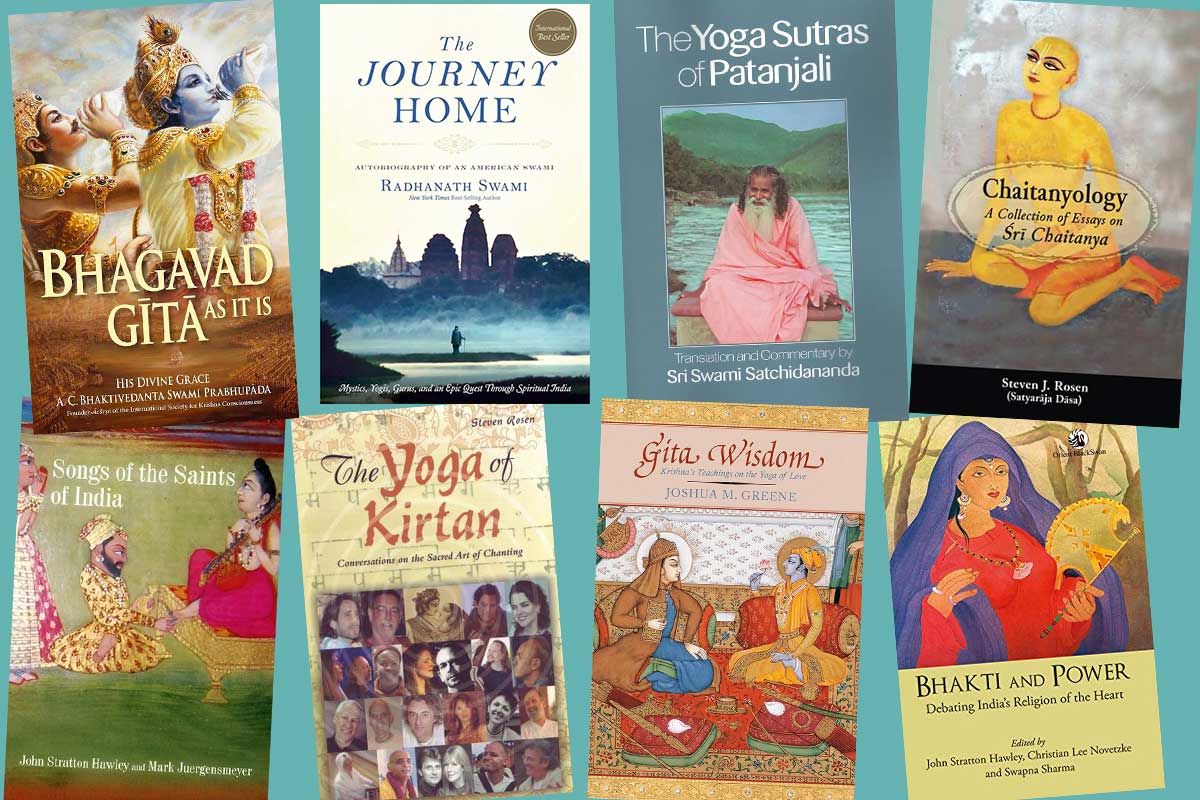
Bhakti Books

You and Bhakti: A Reading List

A friend recently told me her yoga teacher ended class by saying, “Bhakti means self-love.” I winced. No, it doesn’t.

In an age when everything spiritual gets flattened into self-care, we’ve managed to turn one of India’s most radical, world-changing ideas into an Instagram caption. Bhakti—love offered to Krishna, the Supreme Person—has nothing to do with narcissism dressed up as healing. It’s about re-ordering the heart so that love stops orbiting the ego and starts revolving around something greater.

And yet, the confusion makes sense. Over the past century, Bhakti’s deep currents, its theology, poetry, and discipline, have been repackaged for modern consumption, much like Buddhist meditation before it was reduced to feeling good, managing stress, or “manifesting abundance.” Bhakti was never meant to be stress therapy, although that may be a secondary benefit. It was meant to be a revolution of consciousness.

So the teacher in me thought it might be time for a little required reading. The following are books for anyone who has ever wondered: What is Bhakti Yoga? How did an ecstatic spiritual movement that began in medieval India become a playlist on Spotify and a slogan on a T-shirt? How does Bhakti, devotion, interact with reason and social conscience?

Here’s a reading list that can help answer those questions. Some titles explore Bhakti’s historical roots. Others trace its evolution through colonial India into the modern West. A few offer contemporary reinterpretations that restore its philosophical depth.

You don’t need to read all of them. Start with the one that calls to you, whether you’re drawn to sacred poetry, historical context, or spiritual practice. I promise, after reading even one, you’ll never again mistake Bhakti for “just being nice.”

1. Bhagavad Gita As It Is
By A.C. Bhaktivedanta Swami Prabhupada
What you will learn: The Gita is the philosophical root of Bhakti Yoga, a dialogue between Krishna and his warrior-disciple Arjuna that redefines action, duty, and love. Bhaktivedanta Swami’s translation and commentary restore the text’s devotional core, which many modern versions gloss over.
The payoff: You will discover how the Gita’s central teaching, selfless action in loving service, turns ordinary life into a sacred offering.


2. The Journey Home

By Radhanath Swami
What you will learn: A modern memoir tracing an American seeker’s path from the 1970s counterculture to deep immersion in Bhakti practice.
The payoff: Proof that Bhakti can thrive in the modern world—not as nostalgia for the East, but as a universal language of love and service.


3. The Yoga Sutras of Patanjali

Translated and introduced by Edwin Bryant
What you will learn: In this edition of the classical text that shaped yogic philosophy long before the modern wellness era, Bryant’s translation highlights the devotional threads often neglected in secular readings of the text.
The payoff: Bhakti (devotion) and Jnana (study, knowledge) were never rivals. The sages saw love and clarity as twin paths toward the same realization.


4. Chaitanyology: Writings on the Transformative Teachings of Sri Chaitanya Mahaprabhu
By Steven J. Rosen
What you will learn: A lucid, contemporary exploration of Chaitanya Mahaprabhu’s philosophy of bhakti, divine love, drawing from scripture, music, and modern scholarship. Rosen unpacks how Chaitanya’s vision of ecstatic devotion shaped Vaishnava theology and still informs global Bhakti culture today.
The payoff: A bridge between past and present—showing how a 16th-century saint’s message of humility and joy continues to speak to seekers living in a fractured world.


5. Songs of the Saints of India
Translated by John Stratton Hawley and Mark Juergensmeyer
What you will learn: Selections from the great medieval poet-saints, including Mirabai, Tukaram, Surdas, and Kabir, who sang of divine love in vernacular tongues, defying caste and convention.
The payoff: Their verses are as raw and urgent as the blues. You will feel Bhakti as both social protest and mystical awakening.


6. The Yoga of Kirtan
By Steven J. Rosen
What you will learn: A collection of in-depth interviews with leading kirtan artists such as Krishna Das and Jai Uttal, revealing the personal histories, philosophies, and experiences behind Bhakti chants.
The payoff: This book restores the soul to what has too often become performance. It’s a living portrait of Bhakti practice as sound, surrender, and shared joy.


7. Gita Wisdom: An Introduction to India’s Essential Yoga Text
By Joshua M. Greene
What you will learn: A brief modern retelling of the Bhagavad Gita in contemporary language, exploring how its ancient message of selfless love can guide modern life.
The payoff: The Gita’s teachings on Bhakti aren’t about escaping the world; they are about elevating it and turning daily duty into sacred offering, and love into a practical philosophy.


8. Bhakti and Power: Debating India’s Religion of the Heart
Edited by John Stratton Hawley
What you will learn: Scholars debate whether Bhakti was a challenge to power or a tool of it—an uncomfortable but essential conversation.
The payoff: This collection reminds us that love, when authentic, is never sentimental. It is disruptive, demanding, and socially transformative.


Your assignment
Pick one book that speaks to you. Read it not as a spectator but as a participant. For extra credit, read two, and you may find yourself doing something quietly radical in the year to come: loving the world not for what it gives you, but for what you can give back.
rotten at apple studios

Rotten At Apple Studios

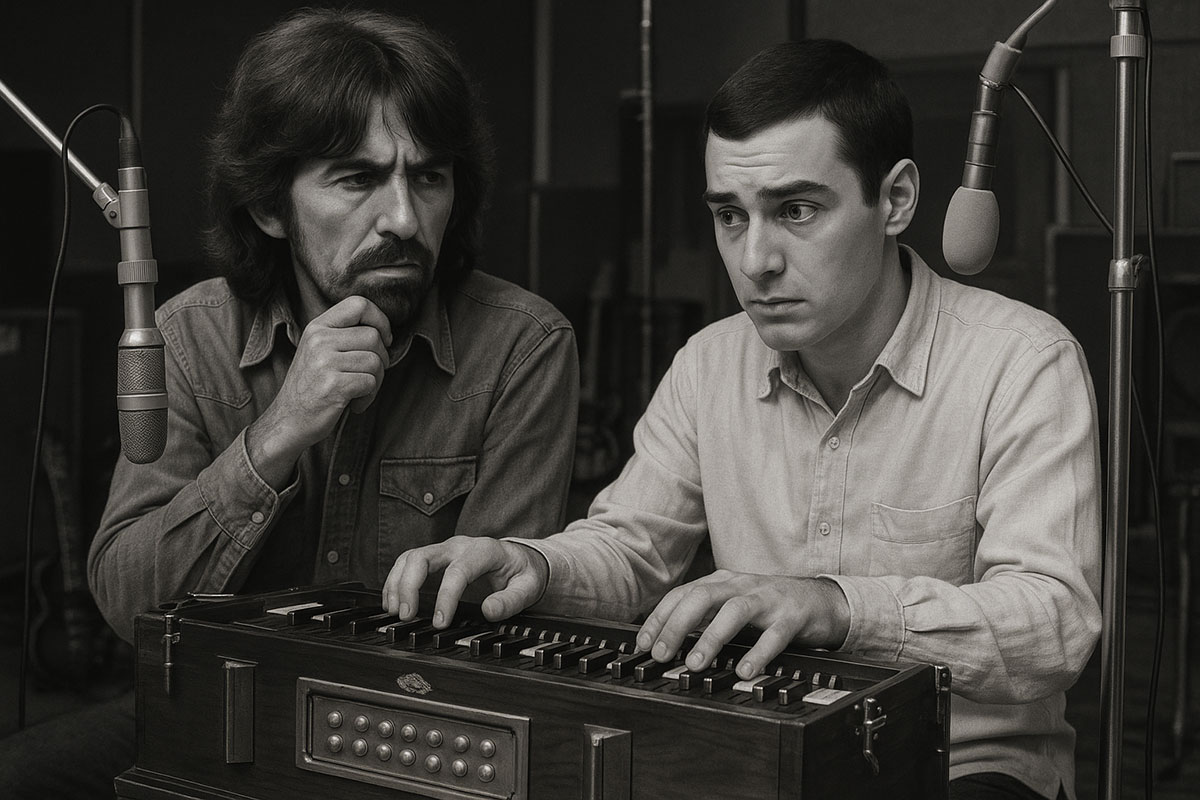
Back in 1970, at age twenty, I left the Sorbonne University in Paris where I had been studying literature and began studying the Bhagavad Gita at the Krishna temple in London. It was also the year George’s single, “My Sweet Lord,” became the most successful solo release by any of the Beatles. The recording reflected his growing interest in mantras and meditation, and the week I arrived he was producing an album of Indian devotional songs with the London Krishna devotees. I had the good karma to be invited to play harmonium during recording sessions at Apple Studios. The harmonium was a small hand-pumped keyboard instrument, and it felt close enough to playing an organ that I was able to pick up the notes and jump in.

During sessions, George’s pure perception of the devotional spirit beneath India’s traditional music affected us all. I, on the other hand, was stuck in rock-n-roll cliches. At one point during an introductory solo to the song “Govinda Jaya Jaya,” I let loose with an embellished riff. George calmly raised an eyebrow and gave me a look that silently said, “Really?”

It took me a minute, but his meaning became painfully clear. We were recording a prayer. This wasn’t the time for showmanship. We were there to serve the sacredness of the mantra. That was a clarifying moment for me, in which George conveyed, with just a look, that less is often more, that simplicity can be more eloquent than elaborate display, and that a good thought is best communicated through refined expression, particularly if one is recording sacred music.

That was more than fifty years ago, and I’m still learning those important lessons. For George, humility in service to Govinda, Krishna, was inseparable from who he was and woven into the very fabric of his being.

Markets Are Up

The Markets Are Up—but My Spirits Are Down

One person’s struggle with cable news and the search for deeper meaning.

Most mornings I make the same mistake: I turn on cable news. I know. Bad idea. Five stories about how the world is going to hell, then, a moment later, a cheerful anchor tells me the markets are up, as though that’s supposed to lift my spirits. But it doesn’t. I check my retirement account, see my few dollars growing, and still feel a kind of hollowness. If the markets are up, why do I feel so down?

The Bhagavad Gita has a word for this restlessness: kama, a Sanskrit term often translated as desire, but a better definition would be longings born of ego. And that doesn’t just mean greed. I’ve caught myself chasing “good” desires, too: publishing more, teaching more, doing more. Noble pursuits, maybe, but still ego driven. The Gita’s warning is that even these polished desires keep us circling in the same karmic loop.

When Work Became Worship
I grew up hearing that hard work was a virtue. My postwar generation has lived by that creed, but the story is older than us baby-boomers. For centuries, the religious establishment was suspicious of wealth. “It is easier for a camel to pass through the eye of a needle than for a rich man to enter Heaven,” the Bible warned. Money was considered dangerous, even corrupting.
Then came the Industrial Revolution. Suddenly wealth looked like divine favor. John D. Rockefeller, who built Standard Oil, called petroleum “the bountiful gift of the great Creator.” He poured his fortune into universities and ministries. Piety became measurable in productivity.

Before long, the God part slipped away—work hard and prosper, whether He exists or not—and it’s a credo that still shapes the way many people measure their days.

The Cage We Live In
The French sociologist Max Weber warned back in 1905 that capitalism’s “iron cage” would trap us all “until the last ton of fossil fuel has been consumed.” Not a bad prediction, yet more than a century later, consumer culture has us buying as though natural resources were infinite.

Behind the simple math of how much-longer-can-this-go-on lies something darker. I became vegan years ago after seeing what factory farms do to animals: living beings slaughtered and redefined as units of protein, engineered for efficiency. It was a shock to realize how much suffering could be hidden behind consumption and supermarket packaging. That, too, is kama: “progress” so effectively disguised that life itself becomes commodified.

A Different Measure
The Gita doesn’t tell us to walk away from our life. It doesn’t scold us for wanting things. It simply asks: is this desire freeing you or binding you? That’s a question I try to ask myself these days when I’m about to buy, scroll, or react. Am I moving from clarity or from compulsion? In the Gita, the warrior Arjuna still goes to war. Action is inevitable. The difference is that he acts awake, not asleep.

So What Now?
Markets will rise and fall. What matters is whether we rise and fall with them. Here’s a modest exercise you might find useful. Before the next impulse purchase, ask yourself, who is choosing? Is it the real me, or a me fabricated by the consumer culture around me? On a larger scale, we can push for accountability from industries that profit off our desires while depleting the planet. On a more immediate scale, we can push for the same in ourselves.

The Gita’s teaching is quite practical: act but act awake. And maybe turn off the television.