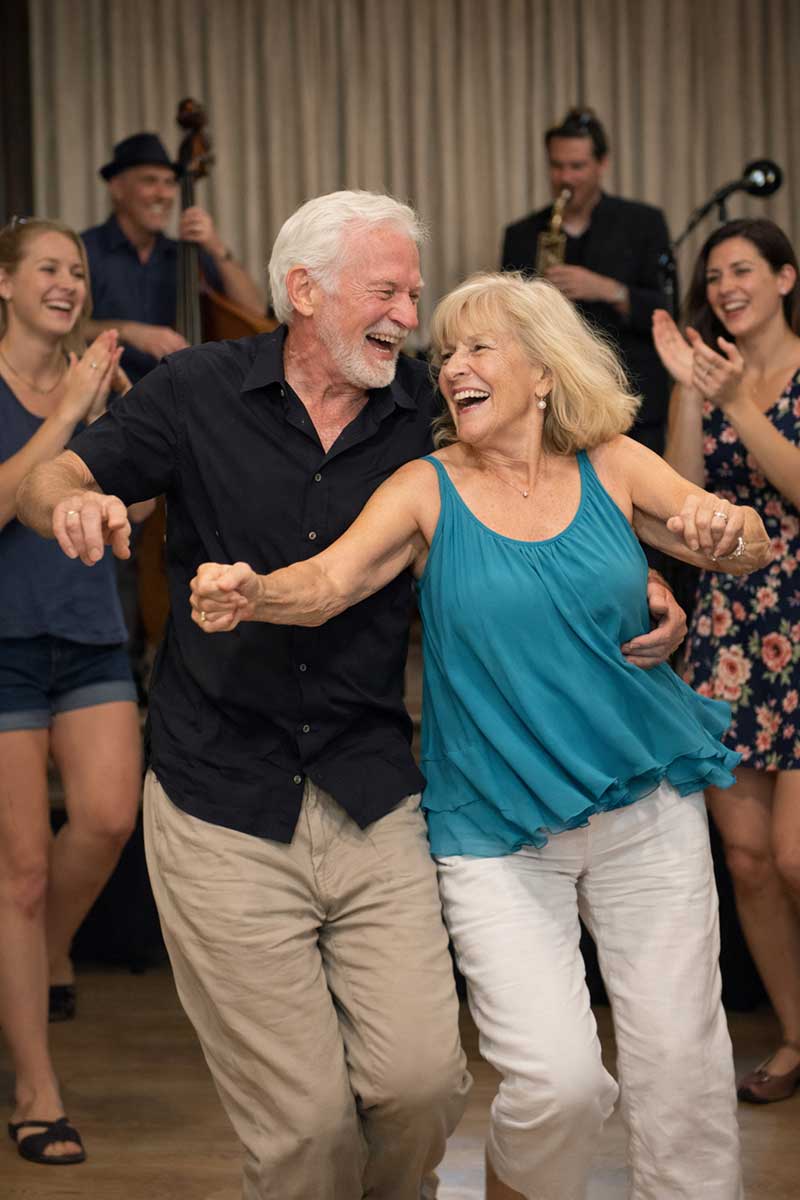
My dear friends, John and his wife, Marcia, are philosophy professors. They’re in their eighties now. They love to dance, and John once made a simple observation about dancing that marked me with its spiritual depth.
When people first learn to dance, he said, they often move mechanically, counting steps, repeating patterns, concentrating hard on “getting it right.” That stage is necessary. You have to learn the basics. But there comes a moment, if the learning has been sustained and patient, when the dancer stops practicing steps and starts being the dance. The concern over “getting it right” disappears and something freer takes over. And that, John says, is when life happens.
You can always tell the difference. A dancer who is still thinking about appearances may look good on the dance floor, but something’s missing. Dancers who don’t care about appearances and just feel the music move differently. Their bodies flow, free, loose, joyful. They’re not trying to dance. They’re dancing. In those moments, John says, we are most ourselves.
The distinction maps beautifully onto a classic idea in bhakti or devotional yoga: the difference between sadhana-bhakti, devotional life in practice, and ragatmika-bhakti, spontaneous devotion. In sadhana, daily practices such as chanting a prescribed number of mantras, studying sacred texts, showing up for worship even when the heart feels distracted or dry—that’s learning the steps. Sadhana seeks to instill discipline, repetition, structure, and intention, like a dance lesson, and it can feel mechanical at times. We follow patterns given by tradition. We imitate the great bhaktas who have progressed farther than we have. We practice not because it feels spontaneous, but because it forms us.
This stage is devotion’s foundation. Without a foundation, love and devotion have nothing to stand on. Just as no one wakes up one day dancing effortlessly. It takes practice. But sadhana is not the destination. It is the preparation for spontaneous love and devotion.
Ragatmika-bhakti describes devotion that has become internalized. Love moves the soul naturally, without calculation. In this place of spontaneous devotion, external judgements, defensive postures, and selfish interests dissolve. Devotion is no longer something we try to do. It arises on its own. The heart leans toward Krishna, the supreme being, the object of love dwelling in the hearts of all, the way a body leans toward its favorite music. There is still form, just as a skilled dancer still respects rhythm and balance, but the form is no longer constrained. It is alive.
In ragatmika-bhakti, practice shows what it has achieved. What once felt mechanical now feels alive and exciting. Devotion flows because it expresses who we have become. Neophyte dancers dance with their feet. The more seasoned dancers dance their hearts out.
John’s insight reminded me of something essential about the life of devotion that I’ve been trying to nurture for more than fifty years: spontaneity is not the opposite of discipline. It is the fruit that matures when discipline has been fully absorbed. The goal is not to remain forever counting steps, nor to abandon the steps prematurely. The goal is to practice so deeply that the practice disappears.
When devotion becomes like dancing at its best—unselfconscious, responsive, joyful—we are no longer “performing spirituality.” We are living it. And in those moments, as John says, we are finally ourselves.