Growing up in midtown New York City in the 1950s, I lived with my mother in a two-room apartment near Central Park. In those days, you could rent a small place in that neighborhood for a few hundred dollars a month. It strained our two-person budget, but she saw a chance to move us out of the slum area where we had been living downtown, and she took it.
Haircuts happened across the street from our building and next door to 1010 WINS radio, a rock ’n’ roll station back then. Next to the barbershop was a used bookstore. For twenty-five cents you could buy an ACE double-novel science fiction paperback. On the corner was a coffee shop serving bagels and coffee to riders pouring out of the 59th Street subway. And right beside our building stood the New York Coliseum.
Before it was torn down in the early 2000s, the Coliseum was the place for all the big expos and fairs. My good fortune was to make friends with a guard posted at a side entrance. Starting at age nine, I saw every show for free.
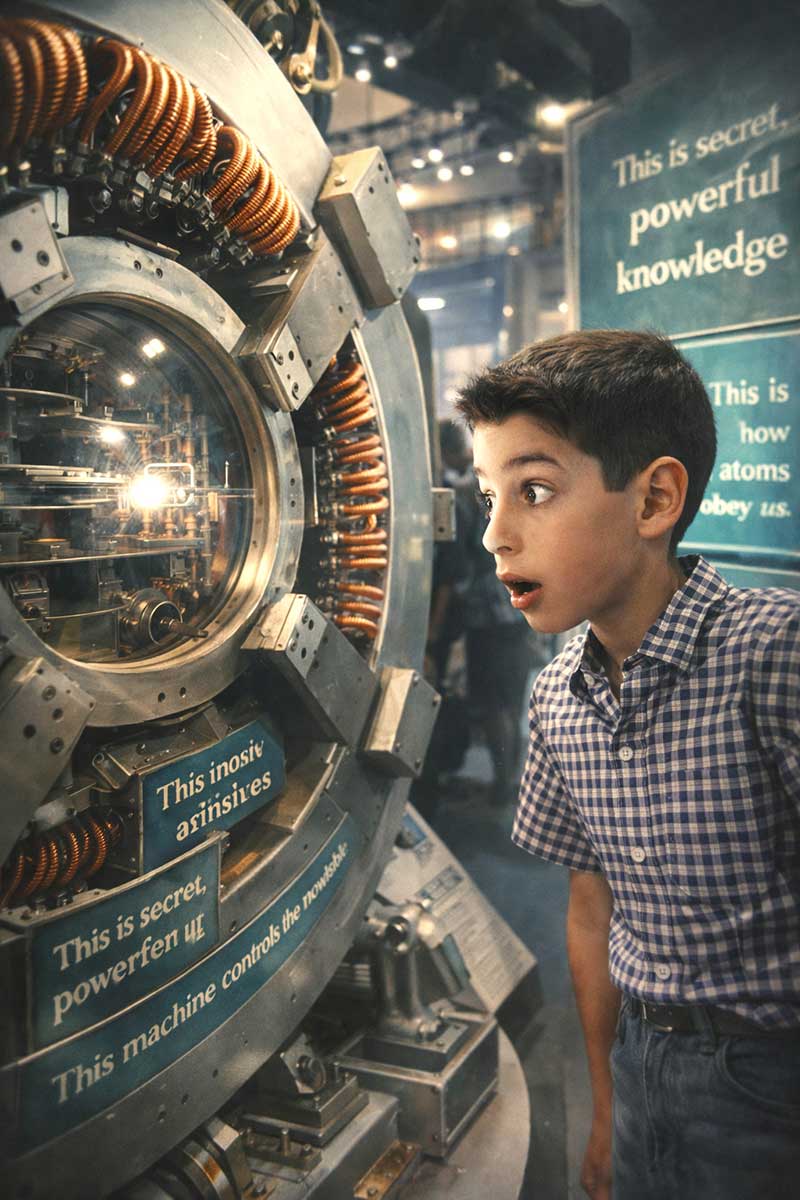
In August 1959, the Coliseum hosted the Soviet Exhibition of Science and Technology. For nine-year-old me, the biggest “wows” were two exhibits. One was a replica of Sputnik hanging near the entrance. The other was a particle accelerator. I remember it as a metal machine perhaps ten feet across, with thick copper windings, heavy magnets, and bold signs proclaiming: “This machine controls the invisible,” “This is how atoms obey us,” and “This is secret, powerful knowledge.” The message was unmistakable: the future belongs to those who master the smallest things.
Standing before that silent ring of metal and copper, I think I sensed for the first time that the most decisive forces in life were unseen. This machine claimed to reveal what could not be observed directly. The idea lodged itself in me that the cool parts of reality lived beneath the surface. If matter was animated by invisible forces, perhaps life itself contained something tiny and mysterious.
Ten years later, I was introduced to the Sanskrit wisdom text Bhagavad Gita, which described the atma, the nonmaterial self that animates mind and body. That idea felt less to me like something new than something remembered. The “wow” in the Coliseum turned out not to be about physics but about tracing consciousness back to its source. What turns matter from something inert into something living? What is that undeniable quality of inner experience that lets us know we are alive?
I didn’t understand it then, but that day at the Coliseum was a turning point. Curiosity became vocation, and the question of how things work gave way to a deeper question.
Who is it that knows?