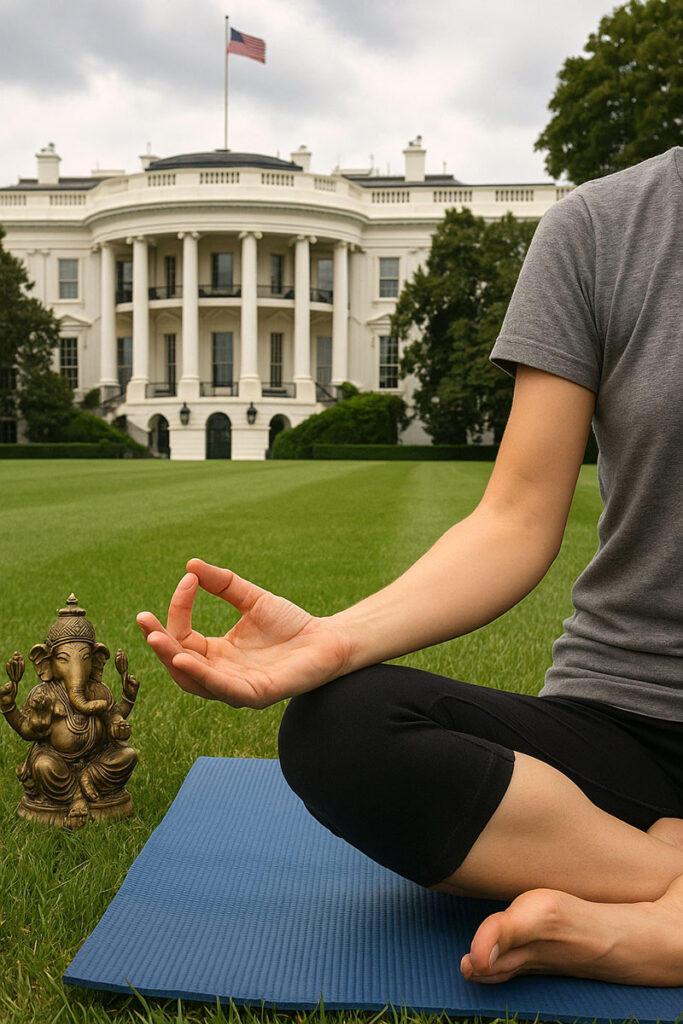
When cultural identity narrows, even a yoga mat can become a battleground.
Few health practices are more commonplace in America today than yoga. Yet what looks like simple exercise continues to provoke unease. For some parents, the Sanskrit chants, statues of deities, and talk of “union with the divine” feel foreign, even unsettling—a quiet challenge to Judeo-Christian norms.
This unease might seem minor in the larger scheme of politics, but it raises a serious question: what happens to practices such as yoga if political authority in Washington continues to consolidate and cultural identity becomes ever more narrowly defined? The Constitution was designed to safeguard pluralism, yet those safeguards are being tested with increasing frequency. Executive power expands daily. Judges earn appointments not based on experience or expertise but perceived party loyalty. And public rhetoric around national identity frames “real America” in increasingly white Christian terms.
Against this backdrop, yoga becomes a revealing test case. School districts from Alabama to California have faced lawsuits over whether yoga in classrooms violates the separation of church and state. Defenders argue it has been thoroughly Americanized and is no more religious than a push-up, but critics frame it as covert Hindu indoctrination.
Both points hold some truth. Much of the yoga in the U.S. has indeed been stripped of its philosophical roots and repackaged as wellness. Yet the suspicion it still provokes shows how vulnerable cultural practices from outside the dominant tradition can be. History offers reminders. In the 19th century, Catholic schools were accused of undermining American values, and some states tried to outlaw them as un-American. During World War II, more than 100,000 Japanese Americans—two-thirds citizens—were uprooted from their homes and sent to internment camps. In the 1950s, McCarthy-era loyalty oaths forced teachers, professors, and artists to prove their patriotism or risk their livelihoods.
Each of these episodes has since been condemned, but at the time they were defended as necessary to protect national identity. The lesson is clear: when cultural difference is cast as a threat, constitutional protections can buckle quickly.
The White House itself has, at times, embraced yoga. Michelle Obama included it in her “Let’s Move” campaign, and sessions have been held on the South Lawn. But symbolic gestures fade when political winds shift, and practices once tolerated can become flashpoints.
This isn’t just about mats and mantras. It is about whether America can still make space for multiple traditions, as it has, often haltingly, in the past. The fate of yoga may matter less than whether freedom in America is strong enough to include the unfamiliar, or so fragile that the unfamiliar must be excluded.
And once that political chakra opens, it rarely closes.