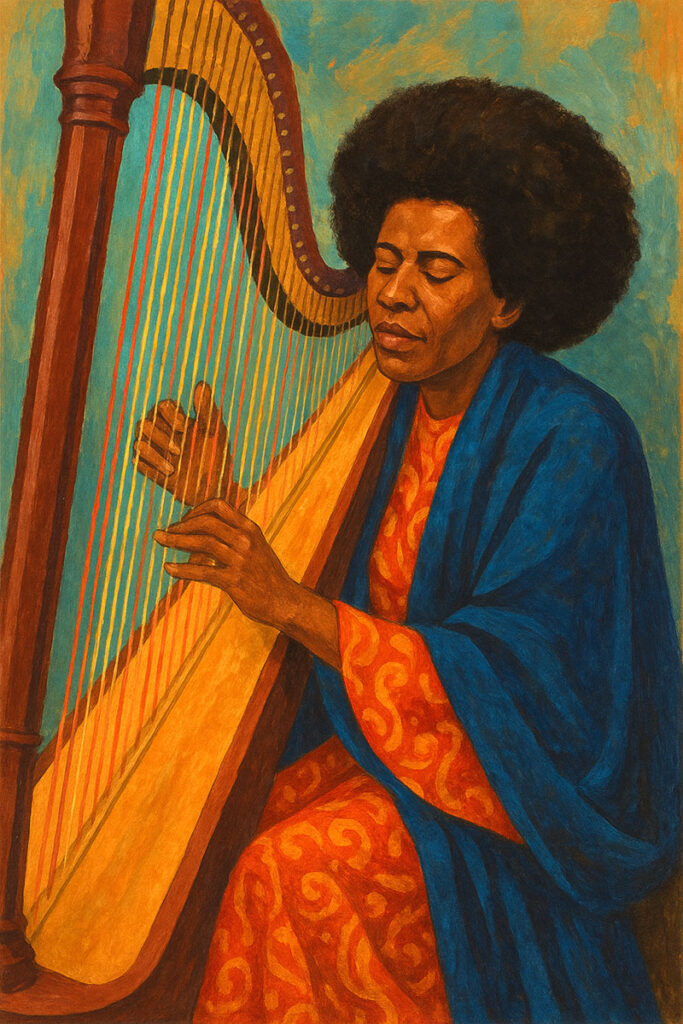
A LIFE IN MUSIC AND DEVOTION
Alice Coltrane (1937-2007) was a gifted musician, visionary composer, and devoted practitioner of yoga and meditation. In January 1981, when I was living in the New York Krishna temple, it was my privilege to help organize a musical tribute to John Lennon, and she agreed to take part. The program was to be a memorial offering to John, who had been murdered one month before.
George Harrison was the Beatle most admired for writing songs that were overtly spiritual; John was the fierce, questioning heart of the band, the one who confronted war and class prejudice and pushed the Beatles’ music into deeper revolutionary waters. For those of us who grew up in the 1960s, his murder marked the end of the sixties dream, a turning point that shattered the idealism we associated with the Beatles, counterculture, and John Lennon’s advocacy for peace. We baby boomers had come of age listening to his music. A memorial concert was the least we could do, and Alice’s participation was altogether fitting.
Most everyone involved with spiritual practices in those days knew about Alice Coltrane. In 1963 she met her future husband, the legendary jazz saxophonist John Coltrane, who credited yoga and meditation with having saved him from drug dependency. After his death in 1967, Alice became a disciple of Swami Satchidananda, founder of Integral Yoga. Soon after, she became known by the Sanskrit name Turiya Sangeetananda, meaning “the supreme being’s song of highest bliss.”
By the late 1970s, Turiya (as she was affectionately known) was a frequent visitor to Krishna temples and began incorporating the devotional music she heard there into her performances and compositions. In 1977 she sent a copy of her album “Radha-Krsna Nama Sankirtana,” featuring gospel-infused renditions of popular Sanskrit chants, to A. C. Bhaktivedanta Swami Prabhupada, founder of the Krishna movement. In March of that year, he sent her a letter of appreciation, praising her chanting and telling her she has become “transcendental” by chanting Govinda Jaya Jaya and the Hare Krishna maha-mantra. Shortly after, she met him in person while on a pilgrimage to Vrindavan, India.
In an interview for Integral Yoga Magazine, she described what it was like to be married to John Coltrane. “He was a very quiet, meditative person,” she said, “very pensive, very deep in thoughts. Many times, you see couples whose personalities are opposite and they clash a lot. That doesn’t make for peace in your heart and home. I felt fortunate to be with someone who had that calm and peace in his spirit. John loved to read spiritual books,” including the Bhagavad Gita and Paramahamsa Yogananda’s acclaimed Autobiography of a Yogi. “He was a person who wanted to look deeper into the esoteric side of life. We would meditate together.”
While preparing for the John Lennon tribute concert, Turiya and I discovered that we had both met Swami Satchidananda at the Unitarian Universalist Church on Central Park West in the late 1960s. “For me to walk into the church and see so many young people gathered together was quite impressive,” she said. “I would see Peter Max, Laura Nyro and others there.”
The first time I heard Swami Satchidananda speak was at the church in July 1969, shortly before the Woodstock Festival, where he gave the opening address. “America is helping everybody in the material field,” he told the Woodstock crowd of nearly a half-million festival-goers, “but the time has come for America to help the whole world with spirituality also.” Then he led the crowd in chanting “Hari Om” and “Rama Rama.”
Turiya opened the tribute at the Krishna temple with a rousing version of the Hare Krishna mantra, but it was her rendition of prayers to the plant goddess Tulasi that got the place rocking. Her lively performance on Hammond organ, supported by two backup singers, had the audience of several hundred up and dancing.
What I remember most about that afternoon was the warmth of her singing. It was clear to all who were there that spirituality had brought her to higher dimensions of musical life. Clearly, she believed Krishna was present in his names, and that anyone could realize him if they sang the names with sincerity and devotion. She credited her late husband with having shown her the power of music and mantras.
“In his heart,” she said, “especially during the last five years of his life [from the time of his acclaimed album “A Love Supreme”], “it was all spiritual songs that came out: ‘Dear Lord, dearly beloved God, Om.’ We heard music coming from him that we hadn’t ever heard before, and I believe it wasn’t all from this world. He played from another realm, a spiritual realm.”
Alice Coltrane died of respiratory failure on January 12, 2007. Her music along with John Lennon’s—music that moves us to create a better, more compassionate world—lives on.