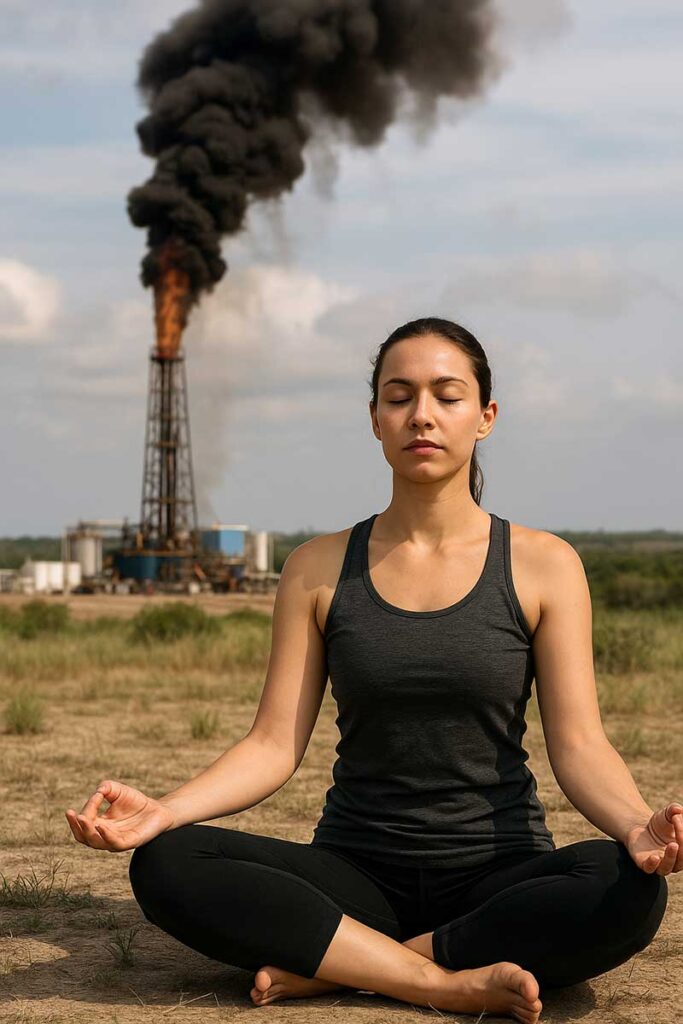
An ancient practice offers surprising insights.
Despite warnings over environmental consequences, oil consumption in the U.S. is nearing historic highs, and efforts to create energy-efficient alternatives have dropped. Yoga culture has something to say about the reversal in direction, and to understand how these seemingly unrelated fields intersect, let’s put our present moment in historic perspective.
How We Got Here
A century ago, German sociologist Max Weber described that prior to the Industrial Revolution, pursuit of wealth was considered a mortal sin and condemned by organized religion. Humility and simplicity ranked higher as Christian ideals than wealth and acquisition.
Encouraged first by Renaissance notions of unlimited human potential, then by explosive developments in communications and transportation technology, those ideals switched places. By this new formulation, hard work and resultant wealth became the real test of piety, and no industry embodied this shift more vividly than oil.
John D. Rockefeller, whose company, Standard Oil, was the most powerful corporation of its day, regarded petroleum as “the bountiful gift of the Creator” and used his fabulous wealth to build churches, endow Christian universities, and underwrite early televangelist ministries. By his reckoning, fossil fuel was not merely a natural resource, it was the sacred link between humans and their Maker. By the 1920s, the religious work ethic was firmly established. Diligent labor would lead to prosperity, and prosperity was proof that God was pleased.
Nature, in this formulation, was an endless resource to be exploited in the pursuit of profits. With grim foresight, Weber predicted that the system would endure “until the last ton of fossil fuel has been consumed.” A century later, his words seem eerily prophetic.
The Trap of More
Soon, however, the theological part of the formula dropped away. What need is there any longer for God, asked the wealthy, since hard work alone has proven itself sufficient for achieving prosperity?
What sustained that ethic, and what still sustains it, was the assumption that progress meant producing more, consuming more, and it is here that yoga culture offers an important corrective. There is evidence of yoga in India dating back at least six thousand years, and from its inception, yoga’s central proposition has been that there is a self beyond matter. Of course, that idea in isolation does not constitute a position on the environment. On its own, yoga does not clean rivers or vote down oil pipelines. But it does suggest that progress can be measured differently—not only in profit margins and energy output but in steadiness, awareness, and restraint.
Most of us don’t sit in the boardrooms where energy futures are decided. We make smaller choices, in how we spend, consume, and live. Modest choices, yes, but cultures are built out of them. The ethic of endless production was not revealed on stone tablets; it was assembled from human decisions. And it can be disassembled the same way.
What Yoga Offers
Yoga culture does not promise redemption. It doesn’t exempt us from the political struggle over energy and the environment. But it does suggest that our sense of wealth and progress is not inevitable, and that redefining those terms is possible. It steadies us when the news tempts us to despair. It keeps alive the idea that prosperity isn’t only about what we take from the earth but also about what we recover from ourselves.
That may sound modest, but modest shifts in definition can change civilizations. The work ethic that linked wealth with divine favor remade the modern world. A culture that measures prosperity not by accumulation but by awareness could do the same.
Yoga culture doesn’t offer easy fixes. What it offers is a way to begin again, to act with clarity, and to remember that change is possible. Each of us can carry that steadiness into our families, our communities, and our work. And if enough of us do, even the largest systems can shift.
Yoga suggests that real prosperity lies in discovering forms of progress that enrich us inwardly, while leaving the world around us whole. At stake is how we have come to measure prosperity itself, and whether a different measure might point us toward something more lasting.